9.3 · Pitch and Loudness Are Different
5.PS.2
Read the standard text
5.PS.2 Light and sound are forms of energy that behave in predictable ways.
Section 1 · LearnLearn the idea
From Ohio 5th Grade Science Power Workbook · Chapter 9 · Lesson 9.3.
Big idea: Pitch depends on how fast an object vibrates. Loudness is a separate property, and changing one does not change the other.
Learning goals: Relate pitch to how fast an object vibrates
Tell pitch and loudness apart
Predict the pitch when a string is tightened or loosened
Fast shaking, high pitch
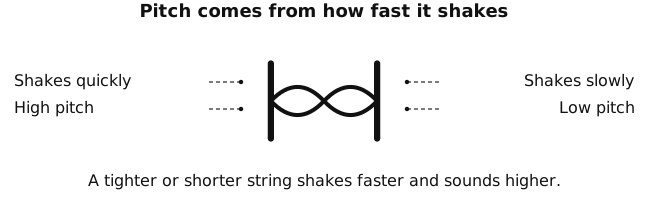
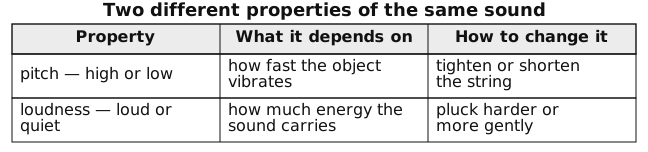
Pitch is how high or low a sound is. It depends on how fast the object vibrates.
Shake quickly and you get a high pitch. Shake slowly and you get a low pitch. Tightening a string makes it shake faster, so the pitch goes up.
Loudness is a different thing entirely
Loudness is how strong the sound is. You change it by how hard you pluck or strike, not by how fast the object shakes.
You can play a high note quietly and a low note loudly. The two properties are completely separate, and mixing them up is the most common mistake in this topic.
Worked examples
Question: A student tightens a guitar string and plucks it gently. Then she loosens it and plucks it hard. Describe what happens to the pitch and to the loudness each time.
Steps: Take pitch first. Tightening makes the string shake faster, so the first note is higher. Loosening makes it shake slower, so the second is lower.
Now take loudness. That depends on how hard she plucked. The first was gentle, so quiet; the second was hard, so loud.
Neither change affected the other property.
Answer: The tight string gives a high pitch played quietly. The loose string gives a low pitch played loudly. Tightness sets the pitch; how hard you pluck sets the loudness.
Common mistakes
Loud is not the same as high
People say a sound is high when they mean loud, and the words get tangled together in everyday speech.
They are separate. Pitch is how fast the object shakes. Loudness is how hard it was struck. A quiet high note and a loud low note are both perfectly ordinary.
Check your thinking: Ask which word the question uses. High and low mean pitch. Loud and quiet mean loudness. They never swap.
Remember
How fast for pitch, how hard for loud
Two questions, two answers. How fast is it shaking? That is the pitch. How hard did you hit it? That is the loudness.
Investigation
Can you change pitch without changing loudness?
Question: Does stretching a rubber band tighter change the pitch of the sound it makes?
Safety: Check the rubber band for cracks before you start, keep it away from your face, and never aim it at anyone.
Materials: one rubber band
an open box or a plastic tub
two pencils
a binder clip
a partner to listen
Steps: Stretch the rubber band around the open box the long way. Slide a pencil under the band near each end of the box. The band will vibrate between the two pencils, and that length must stay the same for every trial, so do not move the pencils.
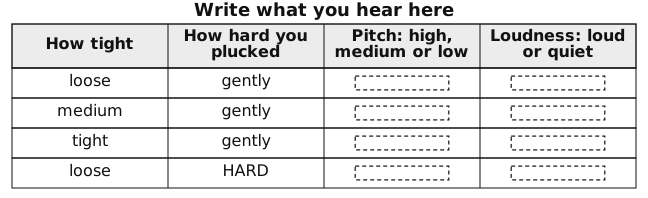
This is the loose setting. Pluck the band gently between the pencils. Write down the pitch (high, medium or low) and the loudness (loud or quiet).
To make the band tighter without moving the pencils, pinch a little of the band together at one end of the box and hold the pinch with the binder clip. This is the medium setting. Pluck gently again, with the SAME strength, and write down both.
Pinch more of the band into the clip at that end so the top is as tight as is safe. This is the tight setting. Pluck gently again and write down both.
Take the clip off so the band is loose again. Now pluck it HARD. Write down the pitch and the loudness.
Repeat all four trials once more, then compare your results.
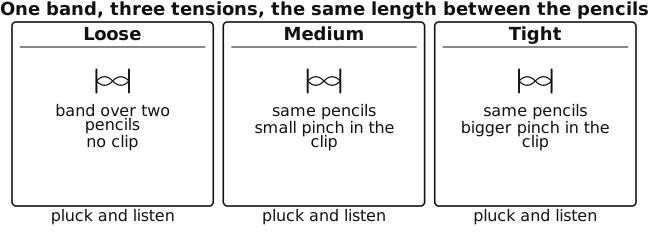
Fair: For the first three trials, only the tightness changes — the same band, the same box, the same two pencils in the same places, and the same gentle pluck each time. The fourth trial changes only the pluck, at the loose setting, to find out what a harder pluck changes.
Cer: Prompt: What did you hear change when the band was tighter, and what changed when you plucked harder?
Claim hint: Say what tightness changed and what a hard pluck changed.
Ev hint: Give the pitch and the loudness you heard in each of the four trials.
Re hint: Explain how tightness, how fast the band shakes, and pitch are linked, and what the hard pluck did and did not change.
Practice tip
Remember: High and low, or loud and quiet?
Tip: Ohio never mixes these words up, so neither should you. High and low always mean pitch. Loud and quiet always mean loudness.
Written practice
A classmate says a loud sound must be a high sound. Explain why this is wrong, and give an example.
Sample response: Pitch and loudness are two different things. Pitch depends on how fast the object vibrates, while loudness depends on how hard it was struck. A big bass drum hit hard is very loud but very low in pitch, and a whistle blown gently is high but quiet.
Scoring guide: 1 point: explains that pitch and loudness are separate properties — pitch depends on vibration rate, loudness on how hard the object was struck.
1 point: gives a workable example, such as a loud low drum or a quiet high whistle.
This targets Ohio's listed misconception that loudness and pitch are related.
Section 2 · DoPractice this standard
These published practice sets are scored on the student site and cover 5.PS.2 directly.
- 01Grade 5 Science · How Light Travels27 questions
- 02Grade 5 Science · Light, Color and Heating31 questions
- 03Grade 5 Science · Sound26 questions
- 04Grade 5 Science · Ohio Science Mixed Review55 questions
- 05Grade 5 Science · OhioCore Academy Full-Length Practice Test 126 questions
- 06Grade 5 Science · OhioCore Academy Full-Length Practice Test 224 questions