10.1 · What an Ecosystem Is
5.LS.1
Read the standard text
5.LS.1 Organisms perform a variety of roles in an ecosystem.
Section 1 · LearnLearn the idea
From Ohio 5th Grade Science Power Workbook · Chapter 10 · Lesson 10.1.
Big idea: An ecosystem is all the living and non-living things in one place. It also includes the ways they affect each other.
Learning goals: Describe what an ecosystem includes
Tell living parts from non-living parts
Give examples of Ohio ecosystems
Living and non-living together
An ecosystem is everything in one place. It includes the living things and the non-living things. It also includes the way they affect each other.
The living parts are the plants, animals and other organisms. The non-living parts include water, soil, air and sunlight.
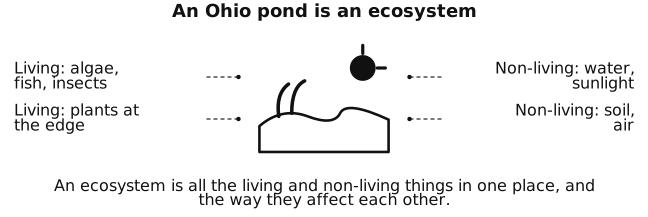
Ohio has many of them
A pond, a woodland, a wetland, a stream, a meadow and even a city park are all ecosystems.
They can be tiny or enormous. What makes something an ecosystem is not its size but that the parts affect each other.
Worked examples
Question: A student lists what is in a woodland: oak trees, squirrels, earthworms, soil and rainfall. Which are living and which are non-living, and why do both belong in the list?
Steps: Sort them. Oak trees, squirrels and earthworms are living. Soil and rainfall are non-living.
Ask whether the non-living parts matter. The trees need the soil and the water to grow.
Because the living things depend on the non-living ones, both belong in a description of the ecosystem.
Answer: Living: oak trees, squirrels, earthworms. Non-living: soil, rainfall. Both belong because the living things depend on the non-living ones.
Common mistakes
An ecosystem is not just the animals
When people picture an ecosystem they picture the creatures in it and forget everything else.
Water, soil, air and sunlight are as much part of the ecosystem as the fish and the foxes — and when one of them changes, the living things change too.
Check your thinking: List the non-living parts on purpose. If your description has only creatures in it, it is not finished.
Ohio connection
Lake Erie is one enormous ecosystem
Lake Erie holds algae, insects, small fish such as minnows, and larger fish that eat them. It also holds the water itself, the sunlight reaching the surface and the sediment on the bottom.
Change one part and the others feel it. Ohio scientists watch the lake closely for exactly that reason.
Think: Sunlight only reaches the top part of a deep lake. Why would that matter to the algae, and then to the fish?
Remember
Alive, not alive, and connected
Three things make an ecosystem: the things that are alive, the things that are not alive, and the connections between them.
Practice tip
Remember: Non-living parts are part of the answer.
Tip: When Ohio asks you to describe or compare ecosystems, include water, soil, air and sunlight. Many questions turn on one of those changing.
Written practice
Describe an Ohio pond as an ecosystem. Name two living parts and two non-living parts, and explain one way a non-living part affects a living one.
Sample response: Living parts of an Ohio pond include algae and fish. Non-living parts include the water and the sunlight. The sunlight matters to the algae because algae use the sun's energy to make their own food, and if the algae had no sunlight the fish that eat them would have less food too.
Scoring guide: 1 point: names two living parts and two non-living parts correctly.
1 point: explains a real connection, such as sunlight letting the algae make food, or water being needed by everything in the pond.
Ohio assesses the roles and relationships of organisms within an ecosystem, which means the connections, not just a list.
Section 2 · DoPractice this standard
These published practice sets are scored on the student site and cover 5.LS.1 directly.
- 01Grade 5 Science · Ecosystems and the Roles Organisms Play33 questions
- 02Grade 5 Science · Producers, Consumers and Decomposers34 questions
- 03Grade 5 Science · Food Chains and Food Webs38 questions
- 04Grade 5 Science · Ohio Science Mixed Review55 questions
- 05Grade 5 Science · OhioCore Academy Full-Length Practice Test 126 questions
- 06Grade 5 Science · OhioCore Academy Full-Length Practice Test 224 questions
- 07Ecosystems and energy: unit practice test12 questions