9.2 · Sound Needs Something to Travel Through
5.PS.2
Read the standard text
5.PS.2 Light and sound are forms of energy that behave in predictable ways.
Section 1 · LearnLearn the idea
From Ohio 5th Grade Science Power Workbook · Chapter 9 · Lesson 9.2.
Big idea: Sound travels outward from its source through solids, liquids and gases — but it cannot travel through empty space.
Learning goals: Explain what sound needs in order to travel
Compare how sound travels through solids, liquids and gases
Explain why there is no sound in space
Outward in every direction
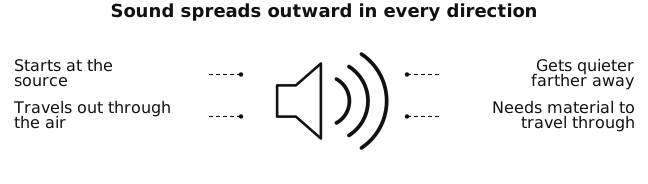
Sound travels outward from wherever it was made, in every direction at once. That is why a person anywhere in a room can hear a clap.
The farther you are, the quieter it gets, because the sound has spread out over more space by the time it reaches you.
Solids, liquids and gases all carry it
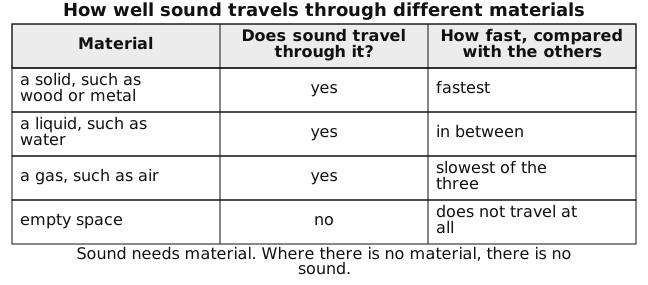
Sound can travel through a solid, a liquid or a gas. Put your ear to a table and tap the far end — the sound gets through the wood easily.
It actually travels fastest through solids and slowest through gases like air. A solid carries the shaking along quickly.
Nothing to shake means no sound
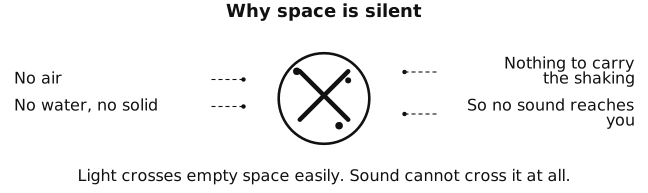
Sound needs material to travel through. In empty space there is no air, no water and no solid.
So sound cannot cross empty space at all. Two astronauts floating side by side cannot hear each other without radios, however loudly they shout.
At a new material
When sound reaches a new material it can do three things: pass through it, bounce back (reflect), or be soaked up (absorbed) so it goes no farther.
Soft, thick materials absorb sound well. That is how a music room is made quieter for its neighbors.
Worked examples
Question: A student puts one ear flat on a long wooden table while a friend taps the far end gently. The tap sounds clear and loud. Explain why.
Steps: Ask what the sound has to travel through. Through the wood, rather than through the air.
Ask whether a solid can carry sound. It can: the vibration from the tap passes along the wood to the ear.
Wood is a solid and carries sound well, so the tap comes through clearly even though it was gentle. Hearing it clearly shows the wood carried it. It does not measure how fast the sound moved.
Answer: The sound traveled through the wood, which is a solid. Solids carry sound well, so the tap sounded clear even though it was gentle.
Common mistakes
Air is the slowest, not the fastest
Nearly every sound we hear arrives through air, so air feels like sound's natural home and its best route.
Sound actually travels fastest through solids and slowest through gases. Solids also carry sound well: put your ear on a table and a gentle tap comes through clearly.
Check your thinking: Order them in your head: solid fastest, liquid in between, gas slowest.
Space really is silent
Movies have spaceships roaring and explosions booming, which makes sound in space feel completely normal.
Sound needs material to travel through. Empty space has none, so no sound crosses it at all. Light crosses it easily, which is why you can see the sun but never hear it.
Check your thinking: Ask what the sound would travel through. If the answer is nothing, there is no sound.
Ohio connection
Hearing a train through the ground before you hear it through the air
People who live near Ohio rail lines sometimes notice a train's rumble through the ground before they hear it through the air.
The rails and the ground are solids, and sound travels faster through a solid than through air. The same sound takes two routes and one arrives first.
Think: Why would putting your ear to the ground let you hear something sooner than standing upright?
Remember
Solid, liquid, gas, nothing
Four cases in order. Solid — fastest. Liquid — in between. Gas — slowest. Nothing — no sound at all.
Practice tip
Remember: Ask what the sound is traveling through.
Tip: Every Ohio question about sound reaching someone has a material in it — air, water, wood, a wall. Find it first. If there is none, there is no sound.
Written practice
Explain why a movie showing a loud explosion in space is not scientifically accurate.
Sample response: Sound can only travel through material such as a solid, a liquid or a gas. Space is empty, so there is nothing there for the shaking to pass through. No sound could reach anyone, so a loud explosion would be completely silent.
Scoring guide: 1 point: says sound needs material to travel through.
1 point: says empty space has no material, so no sound could reach anyone.
This targets Ohio's listed misconception that sound travels through space.
Section 2 · DoPractice this standard
These published practice sets are scored on the student site and cover 5.PS.2 directly.
- 01Grade 5 Science · How Light Travels27 questions
- 02Grade 5 Science · Light, Color and Heating31 questions
- 03Grade 5 Science · Sound26 questions
- 04Grade 5 Science · Ohio Science Mixed Review55 questions
- 05Grade 5 Science · OhioCore Academy Full-Length Practice Test 126 questions
- 06Grade 5 Science · OhioCore Academy Full-Length Practice Test 224 questions