7.3 · What Light Does at a New Material
5.PS.2
Read the standard text
5.PS.2 Light and sound are forms of energy that behave in predictable ways.
Section 1 · LearnLearn the idea
From Ohio 5th Grade Science Power Workbook · Chapter 7 · Lesson 7.3.
Big idea: When light meets a new material it can bounce off, pass through, be soaked up, or change direction as it crosses in.
Learning goals: Name what light can do when it meets a new material
Predict whether you can see through a material
Compare how fast light and sound travel
Four things can happen
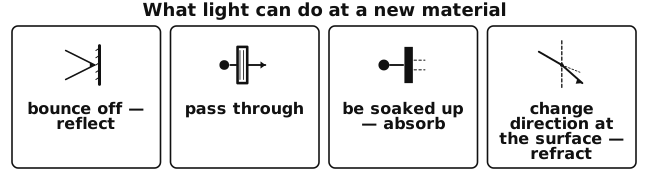
When light reaches a new material it can reflect — bounce off. It can pass through. It can be absorbed — soaked up. And as it crosses into the new material it can be refracted, which means its direction changes at the boundary.
Usually more than one of these happens at the same time. A window lets most light through and reflects a little.
That is why some things are see-through
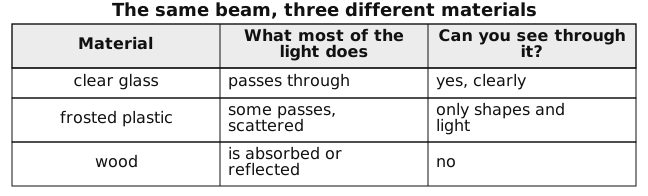
If most of the light passes straight through, you can see clearly through the material, like clear glass.
If light passes through but gets scattered, you see light and shapes but no detail, like frosted plastic. If almost no light gets through, you cannot see through it at all.
Light is much faster than sound
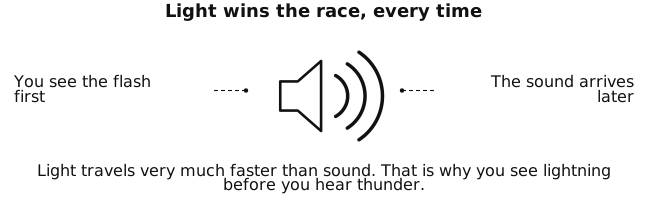
Light travels very much faster than sound. In a thunderstorm you see the flash first and hear the thunder afterwards, even though both started at the same moment.
Worked examples
Question: A student shines a flashlight at a window at night. Some light goes outside and she also sees a faint reflection of herself. Explain how both can happen at once.
Steps: Ask what light can do at a new material. Reflect, pass through, be absorbed, or change direction crossing in.
Ask whether only one of them has to happen. It does not — several can happen to different parts of the light at the same time.
Most of the light passes through the glass, and a small part bounces back.
Answer: Most of the light passes through the glass and goes outside, while a small part of it reflects back, which is the faint image she sees.
Common mistakes
Light changes direction at the edge, not in the middle
Light really can change direction when it goes from air into water or glass. That change happens exactly where the two materials meet.
Once it is inside the water, it travels straight again. Light does not curve along as it goes.
Check your thinking: Look for the boundary. Any change of direction happens at the line between two materials.
Remember
Bounce, pass, soak
Three words cover three of the four; the fourth is refract, a change of direction at the surface. Light can bounce off, pass through, or be soaked up. Often more than one at once.
Practice tip
Remember: Ohio's current test does not ask which way light bends.
Tip: Ohio's specifications say predicting the direction of refraction is not assessed. You are asked THAT light changes direction at a boundary, and what else it can do — reflect, pass through, be absorbed.
Written practice
A straw in a glass of water looks broken at the water's surface. Explain what is happening to the light, and say exactly where the change takes place.
Sample response: The light coming from the part of the straw under the water changes direction as it crosses out of the water into the air. That change happens right at the surface where the two materials meet. Inside the water and inside the air the light travels straight, which is why the straw looks like it breaks exactly at the line.
Scoring guide: 1 point: says the light changes direction, or is refracted, as it crosses between the water and the air.
1 point: states that the change happens at the boundary, or surface, between the two materials — not inside either one.
The direction of the bend is NOT assessed by Ohio. Where the change happens is, and it targets the listed misconception that light bends within a medium.
Section 2 · DoPractice this standard
These published practice sets are scored on the student site and cover 5.PS.2 directly.
- 01Grade 5 Science · How Light Travels27 questions
- 02Grade 5 Science · Light, Color and Heating31 questions
- 03Grade 5 Science · Sound26 questions
- 04Grade 5 Science · Ohio Science Mixed Review55 questions
- 05Grade 5 Science · OhioCore Academy Full-Length Practice Test 126 questions
- 06Grade 5 Science · OhioCore Academy Full-Length Practice Test 224 questions