7.2 · Making Light and Reflecting Light
5.PS.2
Read the standard text
5.PS.2 Light and sound are forms of energy that behave in predictable ways.
Section 1 · LearnLearn the idea
From Ohio 5th Grade Science Power Workbook · Chapter 7 · Lesson 7.2.
Big idea: Some objects make their own light. Most objects are seen because light bounces off them into your eyes.
Learning goals: Tell objects that make light from objects that reflect it
Explain how you see an object that makes no light of its own
Explain why you cannot see in a completely dark room
Two kinds of object
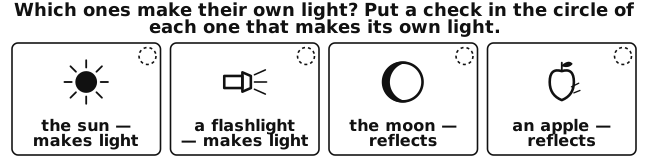
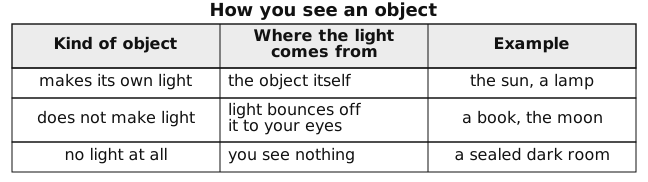
Some objects make their own light. The sun does. So do a lamp, a candle and a phone screen.
Most objects do not make light at all. A book, a wall, the moon — you see them because light from somewhere else bounces off them and travels to your eyes.
Seeing needs light
This is the part worth being careful about. Your eyes do not send anything out. Light has to come into them.
In a room with no light at all, you see nothing, no matter how long you wait. There is no light to bounce off anything.
Worked examples
Question: A student says the moon makes its own light because it shines at night. Explain what is really happening.
Steps: Ask whether the moon is hot and glowing like the sun. It is not.
Ask where the light could be coming from. The sun is shining on the moon.
That sunlight bounces off the moon's surface and some of it reaches our eyes.
Answer: The moon does not make light. Sunlight hits the moon, bounces off, and some of it travels to our eyes, which is why the moon looks bright.
Common mistakes
You cannot see without light
After a while in a dim room your eyes adjust and you start to make things out, which makes it feel as though you can see in the dark.
That room was not completely dark — a little light was getting in and your eyes got better at using it. In a room with no light at all, you would see nothing at all, however long you waited.
Check your thinking: Ask where the light is coming from. If you can see something, light got into your eyes from somewhere.
Ohio connection
Why a lighthouse on Lake Erie works
Lighthouses along Ohio's Lake Erie shore make their own light. That is the whole point: a boat far out has nothing else to see by.
The boat itself does not make light. A lookout sees it because light from the lighthouse, or from the sky, bounces off the boat and back to their eyes.
Think: On a completely dark night with the lighthouse switched off, why would a boat be almost impossible to see?
Remember
Make it or bounce it
Every object you can see is doing one of two things: making light or bouncing it. Anything that glows — sun, stars, lightning, flame, lamp, screen, firefly — is making light. Everything you see that does not glow is bouncing light.
Practice tip
Remember: Trace the light to the eye.
Tip: Ohio's seeing questions want the whole path: a source makes light, the light hits the object, it bounces off, it reaches your eyes. Missing the last step is the usual lost point.
Written practice
Explain how you are able to see this page, starting from where the light comes from.
Sample response: Light comes from a source such as a lamp or a window and lands on the page. The page does not make its own light, so what happens is that the light bounces off the page and travels into my eyes. That is what lets me see it.
Scoring guide: 1 point: identifies a light source, such as a lamp, the sun or a window.
1 point: explains that light bounces off the page and travels into your eyes.
Ohio assesses the difference between emitting and reflecting, and a full answer traces the light from source to eye.
Section 2 · DoPractice this standard
These published practice sets are scored on the student site and cover 5.PS.2 directly.
- 01Grade 5 Science · How Light Travels27 questions
- 02Grade 5 Science · Light, Color and Heating31 questions
- 03Grade 5 Science · Sound26 questions
- 04Grade 5 Science · Ohio Science Mixed Review55 questions
- 05Grade 5 Science · OhioCore Academy Full-Length Practice Test 126 questions
- 06Grade 5 Science · OhioCore Academy Full-Length Practice Test 224 questions