8.1 · Absorbed Light Warms Things Up
5.PS.2
Read the standard text
5.PS.2 Light and sound are forms of energy that behave in predictable ways.
Section 1 · LearnLearn the idea
From Ohio 5th Grade Science Power Workbook · Chapter 8 · Lesson 8.1.
Big idea: Light that is absorbed by an object makes the object warmer. Light that bounces off does not.
Learning goals: Explain what happens to light that is absorbed
Predict which surface will warm more
Explain why a dark surface gets hotter in sunlight
Soaked up, not gone
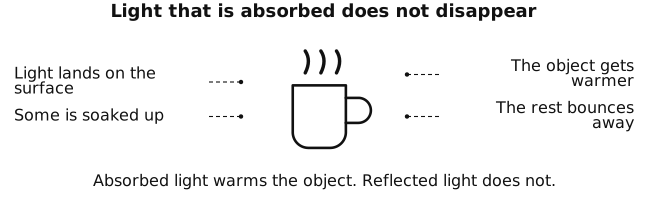
When light lands on an object, some of it bounces off and some is absorbed — soaked up by the material.
Absorbed light does not vanish. It makes the object warmer. That is why sitting in sunlight feels warm.
Dark surfaces absorb more
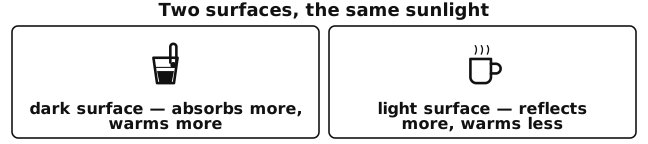
A dark surface absorbs most of the light that lands on it, so it warms up quickly.
A light or shiny surface reflects most of the light away, so it absorbs less and stays cooler.
Worked examples
Question: On a sunny day, a black car seat is painfully hot and a white one beside it is only warm. Both have been in the same sunlight. Explain the difference.
Steps: Both seats received the same amount of light, so that is not the difference.
Ask what each surface does with that light. The black seat absorbs most of it; the white seat reflects most of it away.
Absorbed light warms the object, so the seat that absorbed more got hotter.
Answer: The black seat absorbs most of the light and turns it into warmth. The white seat reflects most of it away, so it absorbs less and stays cooler.
Common mistakes
Reflected light does not warm the object
For two surfaces in the same light, it is not how much light arrives that decides the warming. It is how much is absorbed.
A shiny surface can have a great deal of light landing on it and still stay cool, because nearly all of it bounces straight off again.
Check your thinking: Ask what the surface does with the light, not how much light there is.
Ohio connection
Why an Ohio parking lot is hotter than the grass beside it
On a July afternoon the dark asphalt of a parking lot can be far hotter than the grass a few steps away.
Both got the same sunlight. The dark asphalt absorbs far more of it, so far more of that light becomes warmth.
Think: Some cities are planting trees and using lighter paving. Using what you know about absorption, explain why that would help.
Remember
Soaked up means warmed up
One sentence covers this lesson. Absorbed light warms. Reflected light does not. Dark surfaces absorb more, so they warm more.
Practice tip
Remember: Absorbed or reflected — that is the question.
Tip: A heating question turns on what the surface does with the light. Decide absorbed or reflected first, and the answer follows.
Written practice
Two identical thermometers are placed in the same sunlight. One is covered with black paper, the other with shiny foil. Predict which reads higher after ten minutes, and explain why.
Sample response: The thermometer under the black paper will read higher. Black absorbs most of the light that lands on it, and absorbed light warms the object. The shiny foil reflects most of the light away instead, so much less is absorbed and it stays cooler.
Scoring guide: 1 point: predicts the one covered with black paper.
1 point: explains that black absorbs more of the light while foil reflects most of it, and absorbed light is what warms an object.
Prediction plus a reason drawn from absorption is how Ohio builds 2-point items on this content limit.
Section 2 · DoPractice this standard
These published practice sets are scored on the student site and cover 5.PS.2 directly.
- 01Grade 5 Science · How Light Travels27 questions
- 02Grade 5 Science · Light, Color and Heating31 questions
- 03Grade 5 Science · Sound26 questions
- 04Grade 5 Science · Ohio Science Mixed Review55 questions
- 05Grade 5 Science · OhioCore Academy Full-Length Practice Test 126 questions
- 06Grade 5 Science · OhioCore Academy Full-Length Practice Test 224 questions