8.2 · What Changes How Much It Warms
5.PS.2
Read the standard text
5.PS.2 Light and sound are forms of energy that behave in predictable ways.
Section 1 · LearnLearn the idea
From Ohio 5th Grade Science Power Workbook · Chapter 8 · Lesson 8.2.
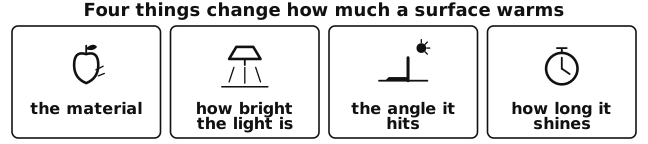
Big idea: Four things change how much a surface warms: the material, how bright the light is, the angle it arrives at, and how long it shines.
Learning goals: Name the four things that change how much a surface warms
Predict the effect of changing one of them
Plan a fair test of one of them
Four things, one at a time
The material decides how much of the light is absorbed rather than reflected.
The brightness of the light matters — a stronger light delivers more to absorb.
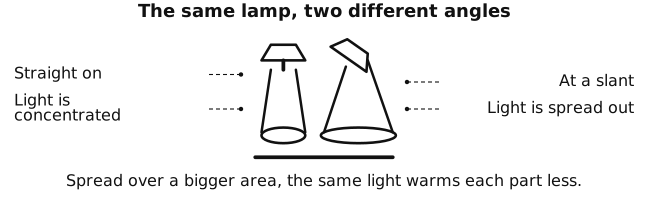
The angle matters. Light arriving straight on is concentrated on a small area. The same light at a slant is spread over a bigger area, so each part gets less.
The time matters. The longer the light shines, the more is absorbed and the warmer the object gets.
Straight on warms most
Point a flashlight straight down at a table and you get a small bright circle. Tilt it and the circle stretches into a large dim oval.
The same amount of light is now spread across more surface, so any one spot receives less of it and warms less.
Reading heating data
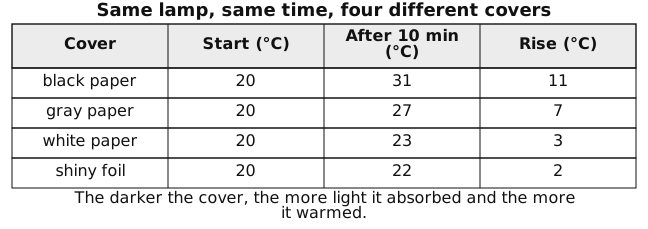
A warming investigation records a starting temperature and an ending temperature. The useful number is the rise — the difference between them.
Comparing rises is fairer than comparing final temperatures, because the samples may not have started at exactly the same temperature.
Worked examples
Question: Use the cover data table. How much more did the black paper warm than the white paper, and what does the comparison show?
Steps: Find each rise. Black rose 11 °C. White rose 3 °C.
Subtract: 11 − 3 = 8 °C more.
Everything else was the same — same lamp, same time, same starting temperature — so the difference came from the material.
Answer: The black paper warmed 8 °C more than the white. Because everything else was held the same, the difference must come from the material absorbing different amounts of light.
Common mistakes
A tilted light is not a weaker light
When light comes in at a slant, the lamp has not become weaker. It is sending out just as much.
What changed is the area it lands on. Spread across more surface, each part gets a smaller share, so it warms less.
Check your thinking: Ask whether the light source changed or the area it covers changed. Tilting changes the area.
Remember
Material, brightness, angle, time
Four words, in that order. When a question asks why one surface warmed more, run through them: was it the material, the brightness, the angle, or the time?
Investigation
Which cover warms the water most?
Question: Which covering lets the water inside warm up the most: black paper, white paper or foil?
Safety: The bulb gets hot: never touch it, and keep the lamp clear of the water. Ask an adult before plugging anything in. Wipe up spills at once.
Materials: three identical clear cups
black paper, white paper and aluminum foil
tape
a thermometer
a measuring cup
water
a sunny window, or an incandescent or halogen desk lamp of 60 W or brighter (an LED lamp will not warm the water enough)
a timer
Steps: Wrap one cup in black paper, one in white paper and one in foil. Tape them so the sides are covered the same way.
Measure 50 mL of water into each cup, all from the same pitcher.
Measure and record the starting temperature of each cup in °C.
Place all three the same distance from the lamp or in the same sunny spot, at the same time. Set the three cups on a curve so each one is the same distance from the bulb (about 15 cm), or test them one at a time from the same marked spot. If you use a lamp, set it low so it shines on the wrapped sides of the cups, not down onto the water.
After 10 minutes, measure and record each temperature again.
Subtract to find the rise for each cup. Expect rises of a few degrees; the order matters more than the size. Then repeat the whole investigation to check.
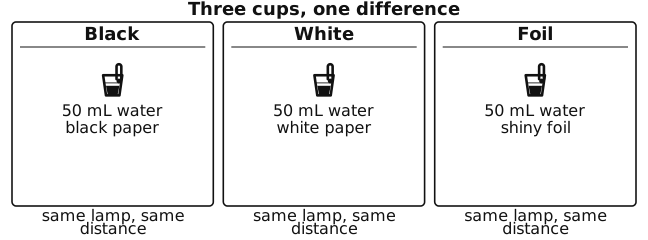
Fair: Same cups, same amount of water from the same pitcher, same starting time, same distance from the lamp, same 10 minutes. The only thing different is what the cup is wrapped in.
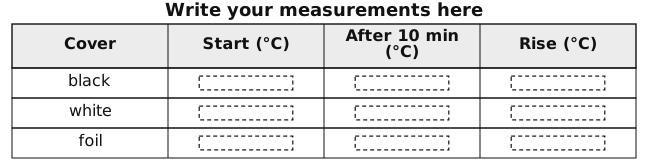
Cer: Prompt: Which cover let the water warm the most, and why?
Claim hint: Name the cover that gave the biggest temperature rise.
Ev hint: Give the rise in °C for all three cups.
Re hint: Explain what that cover did with the light, and why the test was fair.
Practice tip
Remember: Use the rise, not the final reading.
Tip: When Ohio gives you a start and an end temperature, subtract. The rise is what tells you how much light was absorbed, and it is what the comparison should be built on.
Written practice
Plan an investigation to find out whether the angle of a lamp changes how much a surface warms. Name what you would change, two things you would keep the same, and what you would measure.
Sample response: I would change only the angle of the lamp — straight on for one trial and slanted for another. I would keep the same lamp, the same distance from the surface, the same surface material and the same ten minutes. I would measure the temperature of the surface before and after and work out the rise in degrees Celsius.
Scoring guide: 1 point: names the angle of the lamp as the one thing changed, and temperature (or temperature rise) as what is measured.
1 point: names at least two constants, such as the same lamp, the same distance, the same surface, the same time.
Ohio names angle of exposure as one of the four factors, and planning a fair test is exactly what Ohio asks for here.
Section 2 · DoPractice this standard
These published practice sets are scored on the student site and cover 5.PS.2 directly.
- 01Grade 5 Science · How Light Travels27 questions
- 02Grade 5 Science · Light, Color and Heating31 questions
- 03Grade 5 Science · Sound26 questions
- 04Grade 5 Science · Ohio Science Mixed Review55 questions
- 05Grade 5 Science · OhioCore Academy Full-Length Practice Test 126 questions
- 06Grade 5 Science · OhioCore Academy Full-Length Practice Test 224 questions