7.1 · Light Travels in Straight Lines
5.PS.2
Read the standard text
5.PS.2 Light and sound are forms of energy that behave in predictable ways.
Section 1 · LearnLearn the idea
From Ohio 5th Grade Science Power Workbook · Chapter 7 · Lesson 7.1.
Big idea: Light travels in a straight line and keeps going in that direction until it meets something.
Learning goals: Describe the path light takes
Explain why an opaque object casts a shadow
Explain that light can travel through empty space
Straight until something stops it
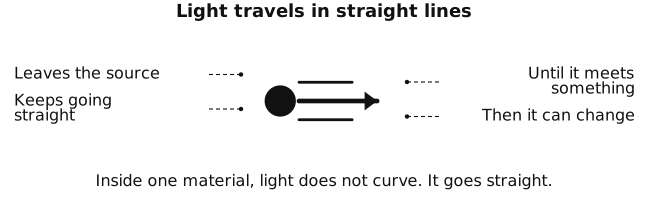
Light leaves a source and travels in a straight line. It keeps its direction until it runs into something.
Inside one material — air, water, glass — light does not curve. It goes straight.
Shadows prove it
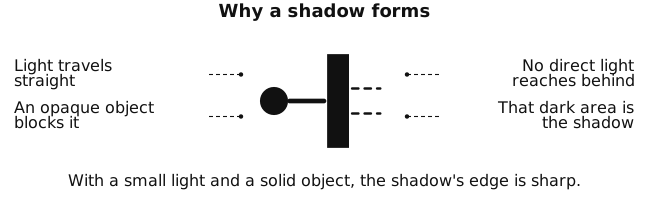
When an opaque object, one that light cannot pass through, blocks the light, no direct light reaches the space behind it. That dark space is a shadow.
Light a solid object with a small source such as a flashlight and the shadow has a sharp edge, because each ray either reaches a spot in a straight line or it does not. A wide source, such as a bright window, lights a spot from many directions at once, so its shadows can have softer edges. That is not light curving. It is many straight rays coming from different places.
Light can also cross empty space. That is how sunlight reaches Earth from the sun.
Worked examples
Question: A student shines a flashlight at a wall and holds a book in the beam. A sharp dark shape appears on the wall. Explain what this shows about how light travels.
Steps: Ask why any part of the wall is dark. Because the book stopped the light that would have reached it.
Ask why the dark shape has a crisp edge. The flashlight is a small source and the book is opaque, so light from it either reaches a spot in a straight line or it does not.
If light curved around the book, the edge would be blurred and the shadow would fill in.
Answer: It shows light travels in straight lines. The book blocks the straight path, so a sharp shadow forms behind it.
Common mistakes
A shadow is not a thing that gets made
It is easy to talk as though an object makes a shadow, the way a lamp makes light.
A shadow is not made of anything. It is simply the place where light did not arrive, because something opaque was in the way of its straight path.
Check your thinking: Do not ask what the object is making. Ask where the light could not reach in a straight line — that place is the shadow.
Remember
Follow the straight line
When a question asks whether light will reach a spot, draw a straight line from the source to the spot. If something opaque is in the way, no direct light gets there. Clear material lets the light through — it may kink at the surface, but it comes out the other side and keeps going straight; a mirror sends it off in a new direction.
Practice tip
Remember: Draw the straight line.
Tip: A question may show a light source, an object and a screen. Draw straight lines from the source. An opaque object stops the rays, so what is behind it gets no direct light. If the question includes clear material, it lets the light through — it may kink at the surface, but it comes out the other side and keeps going straight; if it includes a mirror, keep going after the bounce.
Section 2 · DoPractice this standard
These published practice sets are scored on the student site and cover 5.PS.2 directly.
- 01Grade 5 Science · How Light Travels27 questions
- 02Grade 5 Science · Light, Color and Heating31 questions
- 03Grade 5 Science · Sound26 questions
- 04Grade 5 Science · Ohio Science Mixed Review55 questions
- 05Grade 5 Science · OhioCore Academy Full-Length Practice Test 126 questions
- 06Grade 5 Science · OhioCore Academy Full-Length Practice Test 224 questions