6.1 · Forces Have Size and Direction
5.PS.1
Read the standard text
5.PS.1 The amount of change in movement of an object is based on the mass of the object and the amount of force exerted.
Section 1 · LearnLearn the idea
From Ohio 5th Grade Science Power Workbook · Chapter 6 · Lesson 6.1.
Big idea: A force is a push or a pull. Both how hard it is and which way it acts matter.
Learning goals: Identify forces as pushes or pulls
Describe a force by its size and its direction
Explain how direction changes what a force does
Push or pull, that is all
Every force is either a push or a pull. Kicking a ball is a push. A dog straining on a leash is a pull.
You cannot see a force. You see what it does — an object starts moving, speeds up, slows down, or changes direction.
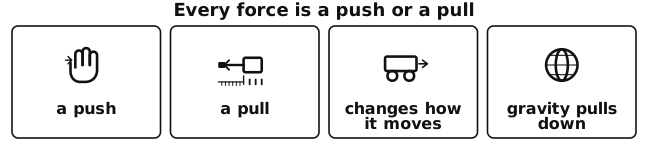
Two things describe a force
To describe a force properly you need its size — how hard — and its direction — which way.
A gentle push forward and a hard push backward do completely different things to the same object, so direction is not a detail.
Worked examples
Question: A student kicks a rolling ball from behind, then a second student kicks an identical rolling ball from the front. Both kicks are the same strength. Describe what happens to each ball.
Steps: Both kicks are forces of the same size, so size is not the difference.
The directions are opposite. One acts the same way the ball is already moving; one acts against it.
A force in the direction of motion speeds the ball up. A force against the motion slows it down.
Answer: The ball kicked from behind speeds up. The ball kicked from the front slows down. The forces are the same size but act in opposite directions.
Common mistakes
A force can slow something down too
When people hear force they picture something being launched. But slowing down is a change in motion too, and so is turning.
Brakes apply a force. So does a hand catching a ball. Both change the motion, just not in the direction the object was going.
Check your thinking: Ask whether the motion changed at all. Speeding up, slowing down and changing direction are all changes.
Remember
How hard, and which way
Describe every force with two things: how hard and which way. Miss either one and you cannot predict what will happen.
Practice tip
Remember: Watch for direction words.
Tip: A question may say a force acts 'in the same direction' or 'in the opposite direction'. Those phrases decide whether the object speeds up or slows down.
Written practice
A goalkeeper catches a moving ball. Explain what force does to the ball's motion, and why catching counts as a change in motion.
Sample response: The goalkeeper's hands push against the ball in the opposite direction to the way it is traveling, which slows it down until it stops. Slowing down and stopping are changes in motion, so a force was needed even though nothing was launched.
Scoring guide: 1 point: says the goalkeeper's hands apply a force against the ball's motion, slowing it or stopping it.
1 point: explains that slowing down or stopping is a change in motion, just as speeding up is.
Ohio's phrase is 'change in movement', which includes slowing and stopping.
Section 2 · DoPractice this standard
These published practice sets are scored on the student site and cover 5.PS.1 directly.
- 01Grade 5 Science · Motion, Distance, Time and Speed22 questions
- 02Grade 5 Science · Balanced and Unbalanced Forces27 questions
- 03Grade 5 Science · Ohio Science Mixed Review55 questions
- 04Grade 5 Science · OhioCore Academy Full-Length Practice Test 126 questions
- 05Grade 5 Science · OhioCore Academy Full-Length Practice Test 224 questions