6.2 · Balanced and Unbalanced Forces
5.PS.1
Read the standard text
5.PS.1 The amount of change in movement of an object is based on the mass of the object and the amount of force exerted.
Section 1 · LearnLearn the idea
From Ohio 5th Grade Science Power Workbook · Chapter 6 · Lesson 6.2.
Big idea: Motion changes only when the forces on an object are unbalanced. Balanced forces leave the motion exactly as it was.
Learning goals: Tell balanced forces from unbalanced forces
Explain what an object at rest needs in order to start moving
Explain what happens to a moving object when the forces are balanced
When forces cancel out
Usually more than one force acts on an object at the same time. What matters is how they add up.
Balanced forces are equal in size and opposite in direction. They cancel out, and the object's motion does not change at all.
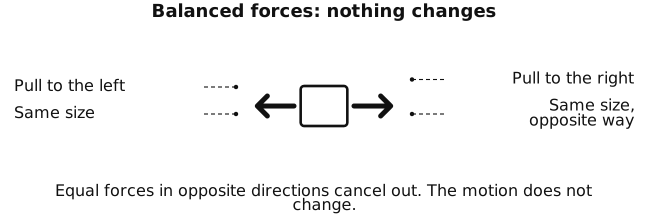
When one force wins
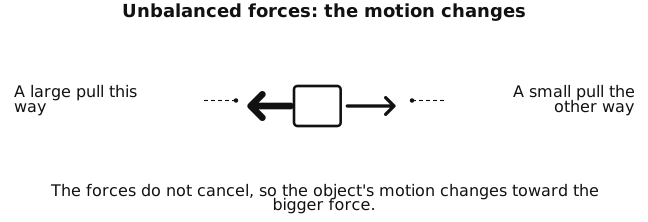
Unbalanced forces do not cancel. One side is stronger, so the object's motion changes toward the stronger force.
An object sitting still needs an unbalanced force to start moving. Balanced forces will never start it.
Already moving, and left alone
Here is the part worth reading twice. An object already moving at a steady speed keeps that speed and direction if no force acts on it, or if the forces on it are balanced.
It does not need a push to keep going. It needs a push to change.
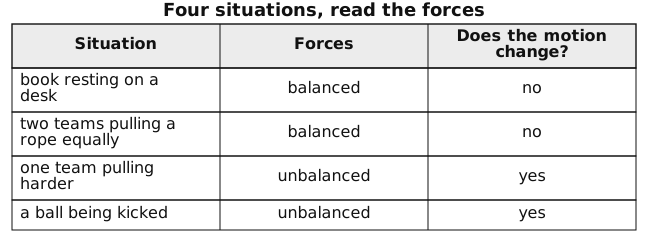
Worked examples
Question: Two teams pull a rope in opposite directions. Neither team moves. Then one team pulls harder. Describe the forces in each case.
Steps: First case: the two pulls are equal in size and opposite in direction, so they are balanced.
Balanced forces cancel, so the rope's motion does not change and nothing moves.
Second case: one pull is now bigger, so the forces are unbalanced and the rope's motion changes toward the stronger team.
Answer: At first the forces are balanced, so nothing moves. When one team pulls harder the forces become unbalanced, and the rope moves toward that team.
Common mistakes
A force can act and still change nothing
Push a parked car as hard as you like and it may not budge. A force was definitely applied.
The reason nothing changed is that other forces were pushing back just as hard. Motion changes only when the forces are unbalanced.
Check your thinking: Before you decide the motion will change, look for a force acting the other way. If it is the same size, nothing changes.
Remember
Equal and opposite means nothing changes
Ask two questions. Same size? Opposite directions? Two yeses means balanced, and balanced means the motion stays exactly as it was.
Investigation
Does a bigger pull move the book farther?
Question: Does stretching a rubber band farther change how far it moves a book?
Safety: Wear eye protection or keep your face away from the rubber band, and never aim it at anyone. Check the band for cracks first.
Materials: a large rubber band, size #117 (about 7 inches long), or two ordinary bands knotted together, that fits around a thin paperback with some slack
a book that slides easily
a ruler or tape measure
a smooth table
tape
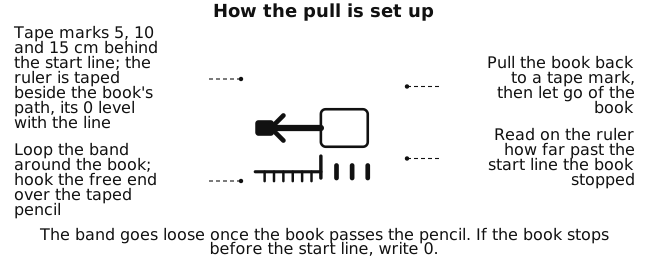
Steps: Mark a start line on the table with a piece of tape. Before taping the ruler down, use it to put three small pieces of tape 5 cm, 10 cm and 15 cm behind the start line. Then tape the ruler flat beside the book's path, not in it, its 0 mark level with the start line and its numbers running the way the book slides.
Tape a pencil flat to the table just past the start line, beside the book's path, with one end sticking out toward the path. Loop the rubber band around the book, set the book with its front edge on the start line, and hook the free end of the band over that end of the pencil. The book will slide past the pencil, not into it.
Pull the book straight back until its front edge is at the 5 cm tape mark. The band stretches. Let go of the book, not the band.
The band goes loose once the book passes the pencil. Use the ruler to measure how far past the start line the front edge of the book stopped, in cm, and write it down. If the book stops before the start line, write 0. A 5 cm stretch may give 0 cm on some tables. That is a real result, not a mistake.
Do the same from the 10 cm tape mark, then the 15 cm tape mark, from the same start line and the same taped pencil.
Repeat all three once more to check your results.
Look at your numbers and describe the pattern.
Fair: The same book, the same table, the same rubber band, the same start line and the same taped pencil every time. The only thing changing is how far the band is stretched, which changes the size of the pull.
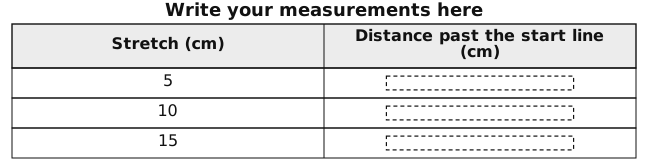
Cer: Prompt: How did the size of the pull change how far the book moved?
Claim hint: State the pattern in one sentence.
Ev hint: Give your measurements for all three stretches, in cm.
Re hint: Use your measurements to explain how the size of the pull affected the book's motion, and why the test was fair.
Practice tip
Remember: 'Does the motion change?' answers most of these.
Tip: If Ohio tells you the motion changed, the forces were unbalanced. If nothing changed, they were balanced. Work backwards from what the object did.
Written practice
A heavy box sits on a floor. Two students push it from opposite sides with equal force and it does not move. Explain why, then say what they could change to make it move.
Sample response: The two pushes are equal in size and opposite in direction, so they are balanced and cancel out, and the box's motion does not change. To move it, one student could push harder than the other, or both could push the same way. Then the forces would be unbalanced.
Scoring guide: 1 point: explains that the two forces are equal and opposite, so they are balanced and the motion does not change.
1 point: says one student should push harder, or both should push the same way, so the forces become unbalanced.
Full credit needs the explanation and the fix, which is how Ohio builds its 2-point items on this statement.
Section 2 · DoPractice this standard
These published practice sets are scored on the student site and cover 5.PS.1 directly.
- 01Grade 5 Science · Motion, Distance, Time and Speed22 questions
- 02Grade 5 Science · Balanced and Unbalanced Forces27 questions
- 03Grade 5 Science · Ohio Science Mixed Review55 questions
- 04Grade 5 Science · OhioCore Academy Full-Length Practice Test 126 questions
- 05Grade 5 Science · OhioCore Academy Full-Length Practice Test 224 questions