5.2 · Working Out Speed
5.PS.1
Read the standard text
5.PS.1 The amount of change in movement of an object is based on the mass of the object and the amount of force exerted.
Section 1 · LearnLearn the idea
From Ohio 5th Grade Science Power Workbook · Chapter 5 · Lesson 5.2.
Big idea: Speed is the distance traveled divided by the time it took.
Learning goals: Calculate speed from a distance and a time
Compare speeds using a data table
Write speed with the right unit
Distance divided by time
Speed tells you how much distance is covered in each unit of time. You find it by dividing.
If a cart travels 20 meters in 10 seconds, its speed is 20 ÷ 10 = 2 meters per second, written 2 m/s.
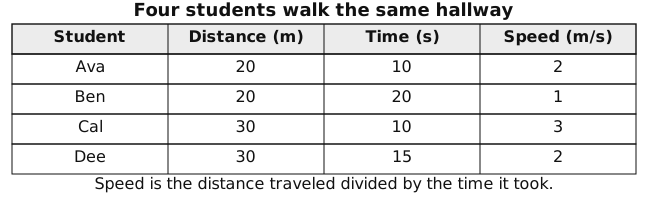
Comparing two moving things
If two objects travel the same distance, the one that took less time was faster.
If two objects travel for the same time, the one that went farther was faster.
If both the distance and the time are different, work out each speed and then compare the numbers.
Worked examples
Question: Use the hallway table. Who walked faster, Ava or Dee? Show your working.
Steps: Ava: 20 m in 10 s. 20 ÷ 10 = 2 m/s.
Dee: 30 m in 15 s. 30 ÷ 15 = 2 m/s.
The distances and times are different, but the speeds are the same.
Answer: Neither. Both walked at 2 m/s, even though Dee traveled farther and took longer.
Common mistakes
Going farther does not always mean going faster
It feels obvious that whoever covered the most ground was fastest. You can only be sure of it if they traveled for the same time. If the times differ, divide.
Check your thinking: Check the times. If they are different, you have to divide — comparing distances alone will mislead you.
Remember
Distance on top
Say it out loud: distance divided by time. Meters per second — the unit even tells you which one goes on top. Whatever comes before 'per' is the one you divide.
Know the speed and the time? Multiply them to get the distance. Know the speed and the distance? Divide the distance by the speed to get the time.
Investigation
How fast do you walk?
Question: How does your speed change when you walk the same 10 meters slowly, normally and fast?
Safety: Use a clear space with nothing to trip on, and walk — do not run indoors.
Materials: a tape measure or meter stick
chalk or tape to mark a line
a stopwatch or a phone timer
a partner to time you
Steps: Measure and mark a straight 10 meter course.
Walk the course slowly while your partner times you. Record the seconds.
Walk it again at your normal pace. Record the seconds.
Walk it a third time as fast as you can walk safely. Record the seconds.
For each trial, divide 10 by your time to find your speed in meters per second.
Repeat the whole thing once to check your results.
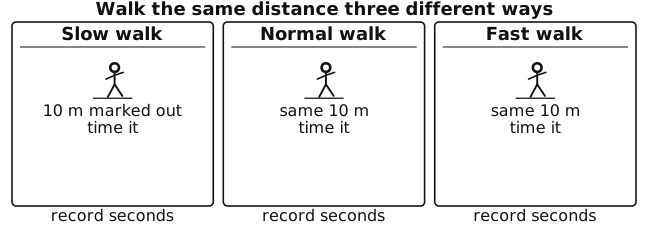
Fair: The distance stays exactly the same every time, the timer starts and stops at the same marks, and the same person walks. The only thing changing is how fast you walk.
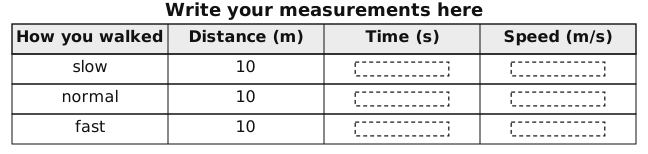
Cer: Prompt: How did walking faster change your time and your speed?
Claim hint: Say what happened to the time and to the speed.
Ev hint: Give your three times and the three speeds you worked out.
Re hint: Explain why a shorter time over the same distance means a larger speed.
Practice tip
Remember: Ohio asks you to type a number, not pick one.
Tip: A speed question can be an equation item with no answer choices. Do the division carefully and check the unit printed next to the answer box.
Written practice
Two students each travel 30 meters. One takes 6 seconds and the other takes 10 seconds. Work out both speeds and say who was faster.
Sample response: The first student's speed is 30 ÷ 6 = 5 m/s. The second student's speed is 30 ÷ 10 = 3 m/s. The first student was faster, because covering the same distance in less time means a greater speed.
Scoring guide: 1 point: both speeds calculated correctly — 5 m/s and 3 m/s.
1 point: states that the student who took 6 seconds was faster, with the reasoning that the same distance in less time is a greater speed.
Full credit needs both the calculation and the comparison, which is how Ohio's 2-point items are scored.
Section 2 · DoPractice this standard
These published practice sets are scored on the student site and cover 5.PS.1 directly.
- 01Grade 5 Science · Motion, Distance, Time and Speed22 questions
- 02Grade 5 Science · Balanced and Unbalanced Forces27 questions
- 03Grade 5 Science · Ohio Science Mixed Review55 questions
- 04Grade 5 Science · OhioCore Academy Full-Length Practice Test 126 questions
- 05Grade 5 Science · OhioCore Academy Full-Length Practice Test 224 questions