5.1 · Describing Motion
5.PS.1
Read the standard text
5.PS.1 The amount of change in movement of an object is based on the mass of the object and the amount of force exerted.
Section 1 · LearnLearn the idea
From Ohio 5th Grade Science Power Workbook · Chapter 5 · Lesson 5.1.
Big idea: An object is in motion when its position changes. To describe that motion you need a distance and a time.
Learning goals: Explain what motion means
Name what you must measure to describe motion
Choose the right units for distance and time
Motion is a change of position
An object is in motion when its position changes. If it ends up somewhere different from where it started, it moved.
Saying something moved is not enough on its own. Scientists want to know how far and how long.
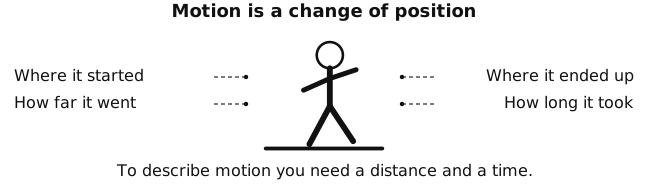
Distance and time, with units
Distance is how far the object traveled. In science that is usually measured in meters (m) or centimeters (cm).
Time is how long the journey took, usually measured in seconds (s).
Both numbers need their unit written with them, or nobody can use them.
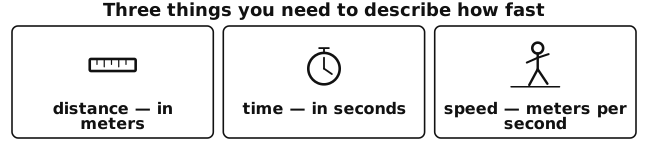
Worked examples
Question: A student writes: “The toy car moved 4.” What is wrong with this description, and how would you fix it?
Steps: Check for a unit. Four what — meters, centimeters, seconds?
Check whether the time is there. Moving 4 meters in 2 seconds is very different from 4 meters in an hour.
A useful description needs a distance with a unit and a time with a unit.
Answer: It has no unit and no time. A fixed version would be: the toy car moved 4 meters in 2 seconds.
Common mistakes
'It moved fast' is not a measurement
Saying a car moved fast tells another person almost nothing. Fast compared with what?
A distance and a time can be compared by anyone. Four meters in two seconds means the same thing to everybody.
Check your thinking: Read your answer back. If it has no number and no unit, it is a description, not a measurement.
Remember
How far, how long
Two questions catch everything in this chapter. How far? That is the distance. How long? That is the time. With both you can work out the speed.
Practice tip
Remember: Motion questions carry units. Keep them.
Tip: Look for m, cm and s in the question, and write the matching unit in your answer. An answer that is just a number can lose the point.
Written practice
A student wants to find out how far a toy car rolls down a ramp. Describe what the student should measure and what tools to use.
Sample response: The student should mark where the car starts and where it stops, then measure between the marks with a tape measure in centimeters. Measuring from the same starting mark every time makes the trials fair to compare. A stopwatch could also time the roll in seconds.
Scoring guide: 1 point: says the thing to measure is the distance the car rolls.
1 point: names a tool that measures distance and the unit it gives: a ruler or tape measure, in centimeters or meters.
Ohio assesses measurements of motion, which means choosing what to measure and with what.
Section 2 · DoPractice this standard
These published practice sets are scored on the student site and cover 5.PS.1 directly.
- 01Grade 5 Science · Motion, Distance, Time and Speed22 questions
- 02Grade 5 Science · Balanced and Unbalanced Forces27 questions
- 03Grade 5 Science · Ohio Science Mixed Review55 questions
- 04Grade 5 Science · OhioCore Academy Full-Length Practice Test 126 questions
- 05Grade 5 Science · OhioCore Academy Full-Length Practice Test 224 questions