4.4 · A Year, and the Changing Night Sky
5.ESS.3
Read the standard text
5.ESS.3 Most of the cycles and patterns of motion between the Earth and sun are predictable.
Section 1 · LearnLearn the idea
From Ohio 5th Grade Science Power Workbook · Chapter 4 · Lesson 4.4.
Big idea: Earth takes about 365 days to travel once around the sun, and that journey changes which stars we can see at night.
Learning goals: State about how long one revolution takes
Explain why different star patterns appear at different times of year
Explain why some stars can only be seen from certain places
One trip around is one year
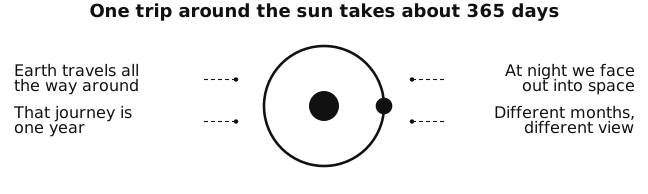
Earth travels all the way around the sun in about 365 days. That journey is called a revolution, and one revolution is a year.
Do not mix it up with rotation. Rotation is Earth turning on itself, about 24 hours, and it gives us day and night.
A different view out the window
At night you are on the side of Earth facing away from the sun, looking out into space.
As Earth moves around its orbit, that view points toward a different part of space. So the star patterns overhead in January are not the ones overhead in July.
Where you stand matters too. Some star patterns can be seen from anywhere, and some only from the northern half of Earth or only from the southern half.
Worked examples
Question: A student sees one star pattern overhead in winter and a different one in summer, and thinks the stars moved. Explain what really changed.
Steps: Ask where Earth is at those two times. It is on opposite sides of its orbit, about six months apart.
Ask which way we face at night. Away from the sun, out into space.
From opposite sides of the orbit, 'away from the sun' points toward different parts of space, so we see different stars.
Answer: The stars did not move. Earth traveled to the other side of its orbit, so at night we face a different part of space.
Common mistakes
Rotation and revolution are not the same word
Rotation is Earth turning on itself, like a top. About 24 hours. It gives day and night.
Revolution is Earth traveling all the way around the sun. About 365 days. It gives a year.
Check your thinking: Ask what the motion is first. Spinning in place is rotation, and Earth's takes about one day (24 hours). Traveling around the sun is revolution, and Earth's takes about one year (365 days).
Ohio connection
The same Ohio field, six months apart
Stand in the same dark Ohio field in January and again in July, look straight up, and the patterns overhead are different.
Nothing in the sky rearranged itself. Earth carried you to the other side of its orbit, and at night you are now facing out toward a different part of space.
Think: If Earth took twice as long to go around the sun, how often would the night sky change back to how it looked before?
Remember
Rotate in place, revolve around
Rotate and rotating in place: 24 hours, day and night. Revolve and going round: 365 days, one year.
Practice tip
Remember: Name the motion before you name the time.
Tip: Decide which motion the question is about: spinning in place is rotation, traveling around the sun is revolution. Then match the time: one rotation is about a day (24 hours); one revolution is about a year (365 days). A question can say 'a day' and still be about rotation.
Written practice
Explain why someone in Ohio sees different star patterns in winter than in summer.
Sample response: In winter and summer Earth is on opposite sides of its orbit around the sun. At night we are on the side facing away from the sun, looking out into space, and from opposite sides of the orbit that view points at different parts of space. So we see different star patterns.
Scoring guide: 1 point: says Earth has moved to a different place in its orbit.
1 point: explains that at night we face out into space, so from a different place in the orbit we face a different part of space.
Ohio assesses the cause of variable star visibility through the year, which is Earth's revolution.
Section 2 · DoPractice this standard
These published practice sets are scored on the student site and cover 5.ESS.3 directly.