2.4 · Moons, Asteroids, Meteoroids, Comets and Dwarf Planets
5.ESS.1
Read the standard text
5.ESS.1 The solar system includes the sun and all celestial bodies that orbit the sun. Each planet in the solar system has unique characteristics.
Section 1 · LearnLearn the idea
From Ohio 5th Grade Science Power Workbook · Chapter 2 · Lesson 2.4.
Big idea: Planets are not the only things orbiting the sun, and each kind of object has its own size, material and path.
Learning goals: Compare asteroids, meteoroids, comets, dwarf planets and moons
Explain what a moon orbits
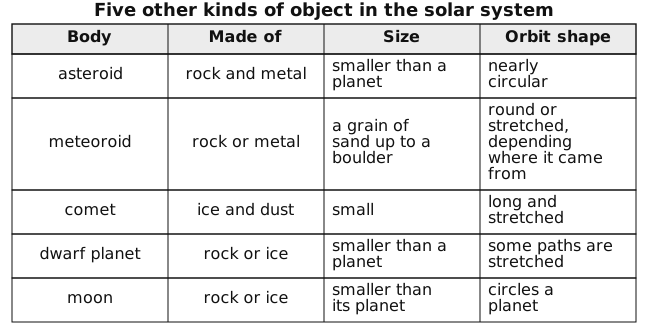
Five other kinds of object
An asteroid is a rocky, metal body that orbits the sun. Asteroids are far too small to count as planets.
A meteoroid is a much smaller chunk of rock or metal that orbits the sun as well — anywhere from the size of a grain of sand up to the size of a boulder. When one falls into Earth's air it burns up in a bright streak, and that streak of light has a different name, a meteor.
A comet is a mixture of ice and dust. Comets travel on long stretched paths, swinging close to the sun and then far away.
A dwarf planet orbits the sun and is round, but it is much smaller than a planet, and it shares its part of space with many other objects.
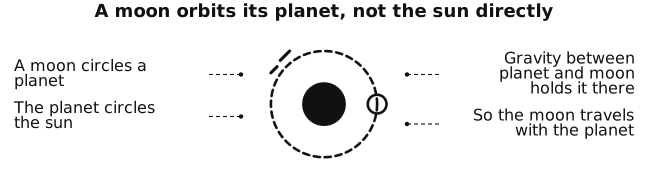
A moon is different from all of these: a moon orbits a planet, and travels with that planet around the sun.
A moon travels with its planet
Gravity between a planet and its moon keeps the moon circling the planet. Meanwhile the planet is circling the sun, so the moon comes along for the ride.
Some planets have no moons. Some have many.
Worked examples
Question: An object orbits the sun. It is made of ice and dust, and its path brings it very close to the sun and then far out again. What kind of object is it?
Steps: Check the material. Ice and dust points to a comet.
Check the path. A long stretched path also points to a comet — planets and asteroids travel on nearly circular paths.
Both clues agree.
Answer: A comet. It is made of ice and dust and it travels on a long stretched path.
Common mistakes
Planets are not the only things with an atmosphere
It is tempting to think a blanket of gas is a planet thing only.
Some moons have an atmosphere too. Being a planet is not what decides it.
Check your thinking: Do not decide what an object has from what it is called. Read what the question actually tells you about it.
Remember
Ice and a long loop means comet
Four quick sorts. Rock, round loop — asteroid. Rock, but tiny — meteoroid. Ice, long stretched loop — comet. Circles a planet — moon.
Practice tip
Remember: Sort by two clues, not one.
Tip: A question will give you the material and the path. Use both. Rock plus a round orbit is an asteroid; ice plus a stretched orbit is a comet.
Written practice
Compare an asteroid and a comet. Give one way they are alike and one way they are different.
Sample response: Both orbit the sun and both are much smaller than a planet. An asteroid is rock and metal while a comet is ice and dust, and a comet's path is much more stretched out.
Scoring guide: 1 point: a correct likeness, such as both orbit the sun, or both are much smaller than a planet.
1 point: a correct difference, such as asteroids are rock and metal while comets are ice and dust, or comets have long stretched paths while asteroids have nearly circular ones.
Comparing and contrasting these bodies by characteristics is one of Ohio's listed response attributes.
Section 2 · DoPractice this standard
These published practice sets are scored on the student site and cover 5.ESS.1 directly.