2.3 · Comparing Planets from Data
5.ESS.1
Read the standard text
5.ESS.1 The solar system includes the sun and all celestial bodies that orbit the sun. Each planet in the solar system has unique characteristics.
Section 1 · LearnLearn the idea
From Ohio 5th Grade Science Power Workbook · Chapter 2 · Lesson 2.3.
Big idea: Planets differ in what they are made of, how big they are, how far they are from the sun and how long one orbit takes.
Learning goals: Compare planets using data you are given
Use what a planet is made of to tell roughly how far out it is
Explain the difference between inner and outer planets
Rocky on the inside, gas on the outside
The planets closer to the sun are made mostly of rock and metal. They are smaller and they are warmer.
The planets farther from the sun are made mostly of gas and ice. They are much larger and much colder.
So if you are told what a planet is made of, you can say roughly where it sits.
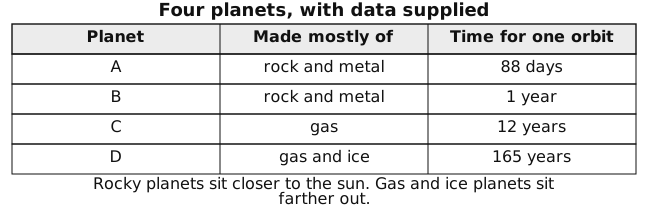
Farther out means a longer year
A planet close to the sun has a short path to travel, so one orbit takes little time. A planet far out has a huge path, so one orbit takes much longer.
Ohio's current test does not ask you to remember these numbers. It gives them to you and asks what they show.
Worked examples
Question: Use the table Four planets, with data supplied in Lesson 2.3. Which planet is most likely farthest from the sun, and how can you tell?
Steps: Look at what each one is made of. A and B are rock and metal. C is gas. D is gas and ice.
Rocky planets sit closer in; gas and ice planets sit farther out.
Now check the orbit times as a second clue. D takes 165 years, the longest of the four, which fits the longest path.
Answer: Planet D. It is made of gas and ice, which fits an outer planet, and its orbit takes the longest time of the four.
Common mistakes
You are not asked to memorize planet data
Many books ask you to learn the planets in order and remember how far each one is. Ohio's current test does not ask for that.
What it asks is whether you can read planet data and say what it shows. The numbers will be printed right there in the question.
Check your thinking: If a question gives you a table, the answer is in the table. Do not reach for something you memorized.
Remember
Rock is near, gas is far
Four words hold most of this topic: rock near, gas far. Small and rocky and warm means close to the sun. Big and gassy and cold means far out.
Practice tip
Remember: The data is in the question.
Tip: Ohio gives you the planet data you need. Your job is to read it and say what it shows — not to recall a number from memory.
Written practice
A planet is very large, extremely cold and made mostly of gas. Describe where in the solar system it most likely orbits, and give your reason.
Sample response: It most likely orbits far from the sun, as an outer planet. The outer planets are the large ones made mostly of gas, and being far from the sun is why it is so cold.
Scoring guide: 1 point: says it is far from the sun, or is an outer planet.
1 point: gives a reason drawn from the description — gas and ice planets are the outer ones, or it is cold because it is far from the sun.
This is the composition-to-distance reasoning Ohio lists as a response attribute.
Section 2 · DoPractice this standard
These published practice sets are scored on the student site and cover 5.ESS.1 directly.