14.3 · Life Science Review
5.LS.1
Read the standard text
5.LS.1 Organisms perform a variety of roles in an ecosystem.
Section 1 · LearnLearn the idea
From Ohio 5th Grade Science Power Workbook · Chapter 14 · Lesson 14.3.
Big idea: Organisms are sorted into roles by how they get energy. The energy in every ecosystem comes from the sun, enters through producers, passes from eater to eater, and flows one way.
Learning goals: Sort organisms into producers, consumers and decomposers
Read a food web and trace energy along its arrows
Explain where an ecosystem's energy comes from and where it goes
Roles in an ecosystem
An ecosystem is all the living and non-living things in one place and the ways they affect each other.
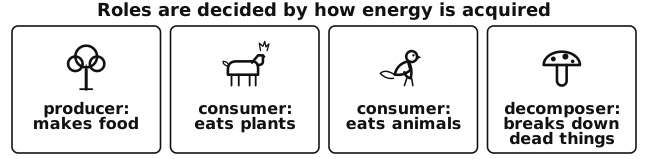
Producers make their own food using the sun's energy. Consumers get energy by eating other living things. Decomposers break down dead plants and animals and return nutrients to the soil. The role is about how energy is acquired, not about size.
Food chains and food webs
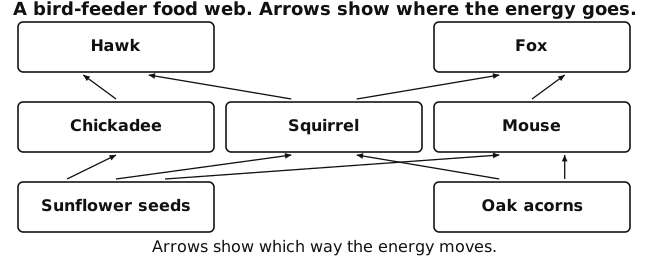
A food chain shows one path of energy. A food web shows many chains joined together, because most organisms eat more than one kind of food.
Every arrow points from the food to the eater. That is the direction the energy moves. Adding or removing one kind of organism changes the whole web, because everything is connected.
Energy flows one way
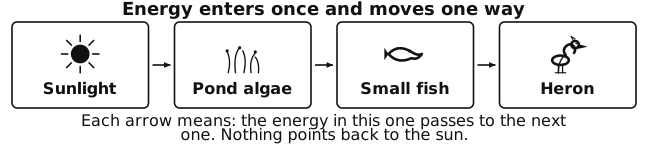
All the processes in a living thing need energy: growing, moving, staying warm, healing. The sun is the original source of that energy for almost every ecosystem.
Energy enters through producers and is passed along when one organism eats another. It is not sent back to the start. Energy flows through an ecosystem in one direction.
Worked examples
Question: In the bird-feeder web in this lesson, the squirrels disappear from the yard. Predict two effects, using the arrows.
Steps: Find every arrow that touches the squirrel. Seeds and acorns point to it. It points to the hawk and the fox.
Follow the arrows into the squirrel. Fewer seeds and acorns are eaten, so more are left for chickadees and mice.
Follow the arrows out of the squirrel. The hawk and the fox each lose a food source, so the hawk may depend more on chickadees and the fox more on mice. Some may leave the yard instead.
Answer: More seeds and acorns for chickadees and mice, and the hawk and fox each lose one of their foods, so the hawk may eat more chickadees and the fox more mice.
Common mistakes
Energy is passed on, not used up
A rabbit eats grass, runs around all day, and by evening is hungry again. It feels as though the energy was simply used up.
It was not destroyed. The rabbit used energy to move, grow and stay warm, and some was passed on to whatever eats the rabbit. The ecosystem needs new energy from the sun every day because energy flows through and moves on, not because it vanishes.
Check your thinking: When a question asks where energy went, look for an answer that names where it moved to. Never pick one that says it disappeared.
Ohio connection
A classroom fish tank is an ecosystem
A tank with water plants, snails and a few small fish is a working ecosystem. The plants make food using light from the lamp. The fish eat the plants and tiny water animals. The snails eat the plants and leftover food. Bacteria in the gravel break down whatever dies, so they are the decomposers.
Turn the lamp off for two weeks and the plants weaken first. Then everything that depends on them does.
Think: A student adds ten more fish to the tank without adding plants. Predict what happens and explain why.
Remember
Follow the arrow, follow the energy
In every food chain or web, the arrow points at the eater. Read it as is eaten by, the way Chapter 12 taught it. It also means gives energy to — both point the same way.
Practice tip
Remember: Trace, then answer.
Tip: Every Life Science item with a food web wants you to follow arrows. Put your finger on the organism in the question and trace backward for where energy came from, forward for who is affected. Then read the choices.
Written practice
A new kind of hawk that eats only mice moves into the yard. Using the bird-feeder food web shown in P14.3.1, predict two changes and explain each.
Sample response: There would be fewer mice, because a new animal is eating them. Then the fox would have less food, because mice are one of its two foods. There might also be more seeds and acorns left, since fewer mice are eating them.
Scoring guide: 1 point: predicts fewer mice, with the reason that a new consumer is eating them.
1 point: predicts a further change that follows, such as the fox having less food, or more seeds and acorns left for squirrels and chickadees.
Introducing a species changes the web along every arrow that touches it, and Ohio asks you to predict those effects.
Written practice
A student says food is the original source of energy for every living thing. Explain what is right and what is wrong about that.
Sample response: It is true that animals get their energy from food. But the food came from producers, and producers got their energy from sunlight. So food is where the energy is stored along the way. The original source is the sun.
Scoring guide: 1 point: says consumers do get energy from food.
1 point: says the energy in the food came from producers, which got it from the sun, so the sun is the original source.
'Food is the original source of energy for all organisms' is one of Ohio's listed misconceptions. Tracing back one more step reaches the sun.
Section 2 · DoPractice this standard
These published practice sets are scored on the student site and cover 5.LS.1 directly.
- 01Grade 5 Science · Ecosystems and the Roles Organisms Play33 questions
- 02Grade 5 Science · Producers, Consumers and Decomposers34 questions
- 03Grade 5 Science · Food Chains and Food Webs38 questions
- 04Grade 5 Science · Ohio Science Mixed Review55 questions
- 05Grade 5 Science · OhioCore Academy Full-Length Practice Test 126 questions
- 06Grade 5 Science · OhioCore Academy Full-Length Practice Test 224 questions
- 07Ecosystems and energy: unit practice test12 questions