14.2 · Physical Science Review
5.PS.1
Read the standard text
5.PS.1 The amount of change in movement of an object is based on the mass of the object and the amount of force exerted.
Section 1 · LearnLearn the idea
From Ohio 5th Grade Science Power Workbook · Chapter 14 · Lesson 14.2.
Big idea: Motion changes only when forces are unbalanced, and how much it changes depends on the force and the amount of matter. Light and sound are forms of energy that behave in predictable ways.
Learning goals: Describe motion and work out speed from distance and time
Tell balanced forces from unbalanced forces by what the motion does
Predict what light and sound do in a new situation
Motion, speed and force
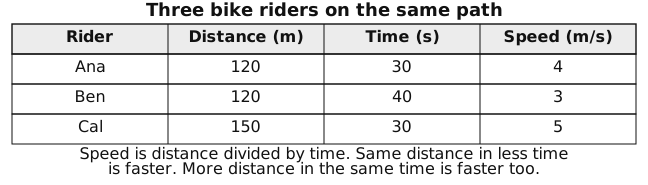
To describe motion you need a distance and a time. Speed is the distance divided by the time. Always write the unit.
A force is a push or a pull with a size and a direction. Motion changes only when the forces on an object are unbalanced. Balanced forces leave the motion exactly as it was, whether the object is still or already moving.
A bigger force changes motion more. An object with more matter changes less for the same force. Gravity is a pull that acts on everything all the time.
Light
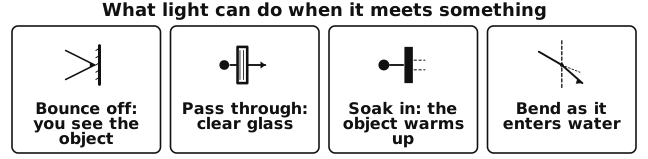
Light travels in a straight line until it meets a new material. Then it can bounce off, pass through, be soaked up, or change direction as it enters.
You see most objects because light bounces off them into your eyes. Light that is absorbed warms the object. An object looks a color because it reflects that color and absorbs the others. White light is all the colors together.
Sound
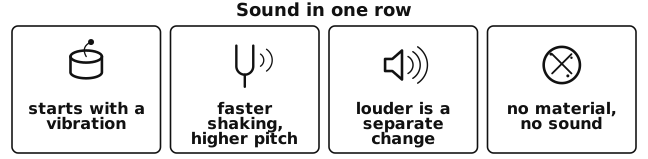
Every sound starts with something vibrating. The vibration travels outward through a solid, a liquid or a gas. With no material to travel through, there is no sound.
Pitch depends on how fast the source vibrates. Loudness is a separate property. You can change one without changing the other.
Worked examples
Question: Two shopping carts are pushed with the same force. One is empty. One is full of groceries. Which cart's motion changes more, and how do you know from the description?
Steps: Find what is the same. The push is the same on both carts.
Find what is different. The full cart has much more matter in it.
Apply the rule. For the same force, the object with more matter changes its motion less.
Answer: The empty cart. Its motion changes more because the same push acts on less matter.
Common mistakes
A force does not always mean a change
A book on a desk has gravity pulling it down, and the desk pushing it up. Two forces, and nothing moves.
The forces are balanced. Only unbalanced forces change motion. When a question shows forces, check whether they cancel before you decide what happens.
Check your thinking: Ask two things: how big is each force, and which way does it act? If they are equal and opposite, the motion stays as it is.
Louder is not higher
Hitting a drum harder makes it louder. It does not make the note higher.
Pitch comes from how fast the source vibrates. Loudness comes from how big the vibration is. They are two different properties.
Check your thinking: If a question changes how hard something is struck or plucked, that is loudness. If it changes the length, tightness or size of the thing vibrating, that is pitch.
Remember
Balanced? Look at the motion, not the forces
You do not need to measure anything. If the motion is staying exactly the same, the forces are balanced. If the object speeds up, slows down or turns, something is unbalanced.
Practice tip
Remember: Physical Science items give you a setup. Use it.
Tip: Ohio describes a situation: two carts, a beam and a mirror, a jar with the air pumped out. Before you pick an answer, say to yourself what is the same and what is different in the setup. The answer follows from the difference.
Written practice
Plan a fair test, including how many times you would run it, to find out whether a heavier cart or a lighter cart travels farther after the same push. Say what you would change, what you would keep the same, and what you would measure.
Sample response: I would use the same cart, once empty and once with a known load. I would push it from the same line with the same push, on the same floor. I would measure how far it traveled with a tape measure, and repeat each trial three times.
Scoring guide: 1 point: changes only the amount of matter in the cart and keeps the push, the surface and the starting point the same.
1 point: measures the distance each cart travels, and repeats the trial.
The D demand asks you to plan an investigation. One variable changed, everything else constant, and a measured result.
Written practice
A town wants its bus shelters to stay cooler on sunny days. Suggest one change to the roof and explain why it works.
Sample response: Paint the roof white or make it shiny. A light surface reflects most of the sunlight instead of absorbing it, and only absorbed light warms the roof. So the shelter stays cooler.
Scoring guide: 1 point: a change that reduces absorbed light, such as a white or light-colored roof or a shiny surface, with the reason that reflected light does not warm the roof.
Designing a solution from the absorb-or-reflect rule is what the T demand asks for.
Section 2 · DoPractice this standard
These published practice sets are scored on the student site and cover 5.PS.1 directly.
- 01Grade 5 Science · Motion, Distance, Time and Speed22 questions
- 02Grade 5 Science · Balanced and Unbalanced Forces27 questions
- 03Grade 5 Science · Ohio Science Mixed Review55 questions
- 04Grade 5 Science · OhioCore Academy Full-Length Practice Test 126 questions
- 05Grade 5 Science · OhioCore Academy Full-Length Practice Test 224 questions