14.1 · Earth and Space Science Review
5.ESS.1
Read the standard text
5.ESS.1 The solar system includes the sun and all celestial bodies that orbit the sun. Each planet in the solar system has unique characteristics.
Section 1 · LearnLearn the idea
From Ohio 5th Grade Science Power Workbook · Chapter 14 · Lesson 14.1.
Big idea: The sun is a star. Everything in the solar system orbits it because of gravity. Earth turns once a day and travels around the sun once a year, and those two motions explain the patterns we see in the sky.
Learning goals: Explain why planets and moons stay in orbit
Compare planets and other objects from data, not from names
Explain day, night, shadows and the changing night sky using Earth's two motions
Gravity keeps everything in its orbit
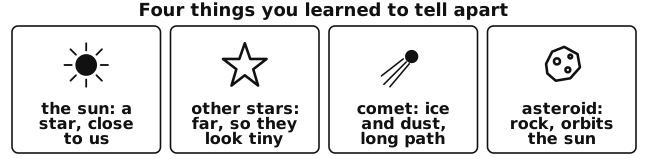
The solar system is the sun and everything that orbits it. That includes planets, their moons, asteroids, meteoroids, comets and dwarf planets.
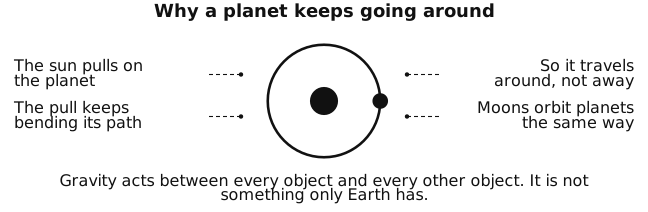
Gravity between the sun and a planet pulls the planet toward the sun. The pull keeps bending the planet's path into a loop. The same thing keeps a moon going around its planet.
Ohio does not focus on naming planets. It will hand you a table and ask you to compare them: size, distance from the sun, what they are made of, how long an orbit takes.
The sun is one star among many
The sun is a star. It looks huge and bright because it is close. Other stars are so far away that they look like points, even though many are as big as the sun or bigger.
Stars appear in patterns that stay the same from night to night. People have used those patterns to find direction.
Two motions, all the patterns
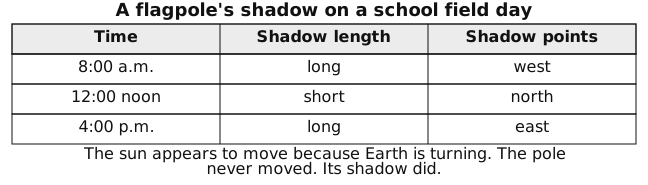
Earth rotates once in about 24 hours. The half facing the sun has day. The half facing away has night. Because Earth turns, the sun, moon and stars appear to move east to west, and every shadow changes length and direction through the day.
Earth revolves around the sun once in about 365 days. As it travels, the night side of Earth faces a different part of space, so the star patterns you see change through the year.
Worked examples
Question: A table lists four objects that orbit the sun. Object W is made of rock and is small. Object X is made mostly of ice and dust and has a long, stretched path. Object Y is large, round and has three moons. Object Z is round, orbits the sun, and shares its part of space with many other objects. Which is most likely a comet?
Steps: Read the table before the question. Ohio puts the clues in the data, not in the names.
Match each description to what you know. Rock and small is an asteroid. Ice and dust with a long path is a comet. Large with moons is a planet. Round, orbiting the sun and sharing its part of space is a dwarf planet.
Object X is the only one made of ice and dust.
Answer: Object X. Comets are ice and dust and travel on long, stretched paths around the sun.
Common mistakes
It is not night everywhere at once
When it is dark where you are, it feels as if the whole world has gone dark.
It has not. Only the half of Earth facing away from the sun is in night. The other half is in daylight at that same moment. As Earth turns, each place moves from one half into the other.
Check your thinking: If a question says it is midnight in Ohio, picture the globe. Ask what the opposite side is facing.
Ohio connection
A night hike in an Ohio state park
Far from town lights, the sky over an Ohio state park shows thousands of stars. Watch for an hour and the whole pattern seems to slide westward.
The stars are not moving across the sky. The ground you are standing on is turning east.
Think: A hiker says the stars in July look different from the stars in January. Explain why, using Earth's trip around the sun.
Remember
Rotate is a day, revolve is a year
Rotate has one syllable that sounds like rote, a spin in place. One spin, one day. Revolve is the long trip around the sun. One trip, one year.
Practice tip
Remember: Read the data before the question.
Tip: Ohio's Earth and Space items almost always come with a table or diagram. Read every row first and underline what changes. The answer is usually a comparison the data supports, not a fact you memorized.
Written practice
Explain why Earth keeps traveling around the sun instead of flying off into space.
Sample response: Gravity between the sun and Earth pulls Earth toward the sun. That pull keeps changing the direction Earth is moving, so instead of going straight it bends around in a loop. Without the pull it would travel off in a straight line.
Scoring guide: 1 point: names gravity between the sun and Earth as the cause.
1 point: explains that the pull keeps changing Earth's direction, bending its path into an orbit.
Ohio's content elaboration says gravitational forces between the sun and each planet continuously change the planet's direction so it remains in orbit.
Written practice
A friend says the stars travel around Earth every night. Explain what is really happening and give one piece of evidence.
Sample response: The stars are not going around Earth. Earth is rotating, and that makes everything in the sky seem to slide from east to west. Evidence: the sun, the moon and the stars all appear to travel the same way across the sky every day, which fits one turning Earth better than everything in space moving the same way at once.
Scoring guide: 1 point: says Earth is rotating, and the stars only appear to move.
1 point: gives evidence, such as the sun, the moon and the stars all appearing to travel the same way across the sky each day, which one turning Earth explains more simply than everything in space moving the same way at once.
'The sun and stars revolve around the Earth' is one of Ohio's listed misconceptions. The apparent motion comes from Earth's rotation.
Section 2 · DoPractice this standard
These published practice sets are scored on the student site and cover 5.ESS.1 directly.