13.1 · Every Living Thing Uses Energy
5.LS.2
Read the standard text
5.LS.2 All of the processes that take place within organisms require energy.
Section 1 · LearnLearn the idea
From Ohio 5th Grade Science Power Workbook · Chapter 13 · Lesson 13.1.
Big idea: Everything a living thing does takes energy — moving, growing, staying warm, healing, even sleeping.
Learning goals: Name processes in living things that need energy
Explain where producers, consumers and decomposers get energy
Explain what happens to the energy an organism uses
Living takes energy
A deer running across a field is using energy. That part is easy to see.
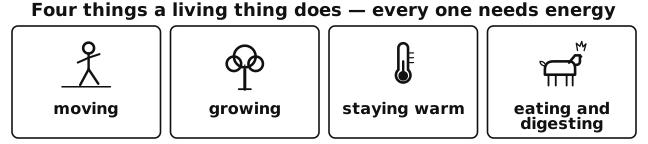
A deer standing still is using energy too. Its heart is beating. It is breathing. It is keeping its body warm. It may be healing a cut or growing new fur.
Every process inside a living thing needs energy. That is true for a deer, an oak tree, an earthworm and you.
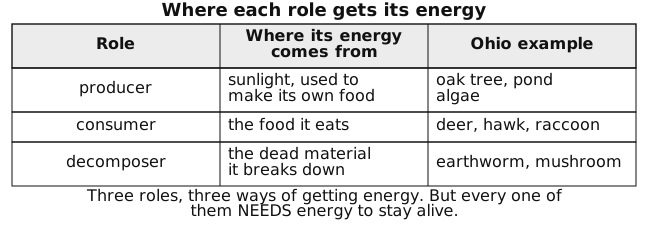
Three roles, three ways to get it
Producers get energy from sunlight and store it in the food they make.
Consumers get energy from the food they eat. Decomposers get it from the dead material they break down.
The way in is different. The need is the same. Cut off an organism's supply of energy and its processes stop.
Worked examples
Question: A groundhog sleeps in its burrow all winter and does not eat. In spring it comes out much thinner. Was the groundhog using energy while it slept?
Steps: Ask what was happening inside the groundhog. It was breathing and its heart was beating. Its body stayed alive.
Those are processes, and every process needs energy.
It was not eating, so the energy came from fat it stored in the fall. That is why it is thinner in spring.
Answer: Yes. Even asleep, the groundhog's body was working, and that took energy. It used stored energy from its fat, which is why it lost weight.
Common mistakes
Energy does not just disappear
After a long run you feel tired, so it seems as if the energy is simply gone.
It is not destroyed. Your body used some of it to move and to grow. Some of it left your body as heat — that is why you felt hot. Energy an organism takes in is used, stored, passed on to whatever eats it, or given off as heat. It moves on. It does not vanish.
Check your thinking: When you want to write 'the energy is gone', ask instead: where did it go? There is always an answer.
Ohio connection
Why an Ohio chipmunk stocks up
Ohio chipmunks spend the fall stuffing acorns and seeds into their burrows. They sleep for long stretches in winter but wake up to eat.
Their bodies keep working all winter, so they keep needing energy. The stored food is the supply.
Think: A chipmunk that stored too little food might not survive to spring. Explain why, using the word energy.
Remember
Alive means using energy
If it is alive, it is using energy right now. Asleep, still, buried in soil — it does not matter. Alive = using energy.
Practice tip
Remember: 'Processes' means everything, not just moving.
Tip: When Ohio asks what needs energy, the answer is every process in a living thing — growing, breathing, healing, staying warm. A wrong answer often picks only the visible one.
Written practice
A classmate says a sleeping animal is not using any energy. Explain why this is wrong. Give one process that is still happening.
Sample response: A sleeping animal is still alive, so it is still using energy. Its heart is beating and it is breathing the whole time. Its body is also staying warm. All of those are processes, and every process in a living thing needs energy.
Scoring guide: 1 point: says the animal is still using energy while asleep.
1 point: names a process that continues, such as breathing, the heart beating, staying warm or healing.
Ohio's statement covers ALL processes in an organism. The ones you cannot see from outside still count.
Section 2 · DoPractice this standard
These published practice sets are scored on the student site and cover 5.LS.2 directly.
- 01Grade 5 Science · Producers, Consumers and Decomposers34 questions
- 02Grade 5 Science · Food Chains and Food Webs38 questions
- 03Grade 5 Science · Energy Flow Through an Ecosystem36 questions
- 04Grade 5 Science · Ohio Science Mixed Review55 questions
- 05Grade 5 Science · OhioCore Academy Full-Length Practice Test 126 questions
- 06Grade 5 Science · OhioCore Academy Full-Length Practice Test 224 questions
- 07Ecosystems and energy: unit practice test12 questions