12.4 · Using a Web to Predict Change
5.LS.1
Read the standard text
5.LS.1 Organisms perform a variety of roles in an ecosystem.
Section 1 · LearnLearn the idea
From Ohio 5th Grade Science Power Workbook · Chapter 12 · Lesson 12.4.
Big idea: When one kind of organism is added or removed, follow the arrows to predict which others change, including ones two steps away.
Learning goals: Predict the effect of removing an organism from a web
Predict the effect of adding a new organism
Explain why organisms two steps away still change
Follow the arrows in both directions
Suppose the rabbits disappear from the woodland web.
Look at the arrows that pointed into the rabbit. The grass loses an eater, so more grass may be left.
Look at the arrows that pointed out of the rabbit. The fox and the hawk lose a food. They may go hungry. The fox may eat more squirrels and insects instead; the hawk may catch more squirrels.
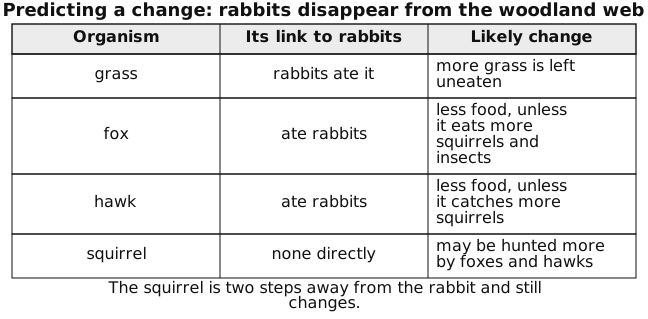
Two steps away still counts
The squirrel had no arrow to the rabbit. It still changes. Foxes and hawks that lost rabbits may hunt squirrels more.
A change spreads along the arrows, one step at a time. Keep following them until nothing else is connected.
Worked examples
Question: A new kind of fish arrives in the pond and eats water insects. Use the pond web from P12.3.6 to predict two effects.
Steps: Find the arrows leaving the water insects. The new fish adds one more arrow out, one more eater, so there may be fewer insects.
Find who else eats water insects. The small fish and the large fish do. They now have less of that food.
Go one more step. The water bird eats small fish. If small fish become fewer, the bird has less food too.
Answer: Fewer water insects, because a new eater has arrived. Less food for the small fish and large fish that also eat insects, and possibly less food for the water bird one step further on.
Common mistakes
The change does not stop at the neighbors
It is easy to name the animal that lost its dinner and stop.
Keep going. That hungry animal may eat more of something else, and that something else changes too. Follow the arrows until there are no more connections.
Check your thinking: After you name the first effect, ask 'and then what?' at least once more.
Ohio connection
When a new eater arrives in an Ohio lake
New kinds of organisms sometimes arrive in Ohio lakes on boats or in bait buckets. If the newcomer eats the same food as a fish already living there, the web changes.
Scientists use the lake's food web to predict which fish will have less food, and which will be affected one step after that.
Think: Why would a scientist draw the food web before deciding what a new arrival might do?
Remember
In, out, and then what?
Removed or added organism: check the arrows in (its foods change), the arrows out (its eaters change), and then ask and then what? for each of those.
Practice tip
Remember: Answer 'and then what?' in writing.
Tip: For a written answer about a change, name the first organism affected, then a second one further along the arrows. Two steps is what earns the second point.
Written practice
Use the pond web shown in P12.4.2. The algae is killed by pollution. Predict what happens to the water insects and to the small fish, and explain using the arrows.
Sample response: Algae is eaten by the water insects and the snails. Without algae, both have only the pond plants to eat, so there may be fewer insects and snails. Small fish eat insects and snails, so the small fish have less food too, one step later.
Scoring guide: 1 point: water insects lose one of their foods, and may become fewer or depend more on pond plants.
1 point: small fish, which eat water insects and snails, then have less food.
Losing a producer at the base spreads upward through every arrow that started there.
Section 2 · DoPractice this standard
These published practice sets are scored on the student site and cover 5.LS.1 directly.
- 01Grade 5 Science · Ecosystems and the Roles Organisms Play33 questions
- 02Grade 5 Science · Producers, Consumers and Decomposers34 questions
- 03Grade 5 Science · Food Chains and Food Webs38 questions
- 04Grade 5 Science · Ohio Science Mixed Review55 questions
- 05Grade 5 Science · OhioCore Academy Full-Length Practice Test 126 questions
- 06Grade 5 Science · OhioCore Academy Full-Length Practice Test 224 questions
- 07Ecosystems and energy: unit practice test12 questions