10.4 · How Organisms Affect One Another
5.LS.1
Read the standard text
5.LS.1 Organisms perform a variety of roles in an ecosystem.
Section 1 · LearnLearn the idea
From Ohio 5th Grade Science Power Workbook · Chapter 10 · Lesson 10.4.
Big idea: Organisms are connected. Some live closely together, and adding or removing one kind of organism changes the whole ecosystem, because the organisms are connected.
Learning goals: Predict the effect of removing an organism from an ecosystem
Predict the effect of adding a new one
Compare three ways two organisms can affect each other
Explain why one change spreads through an ecosystem
Pull one thread and the rest move
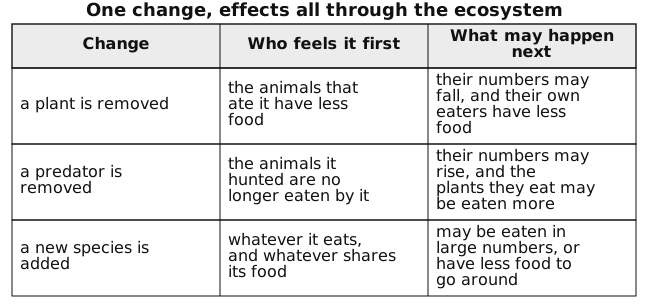
Organisms are connected by what they eat. They are also connected by what eats them. Change one and the effect spreads.
If a plant is removed, the animals that ate it have less food. If a predator is removed, the animals it hunted may increase.
Some organisms live closely together
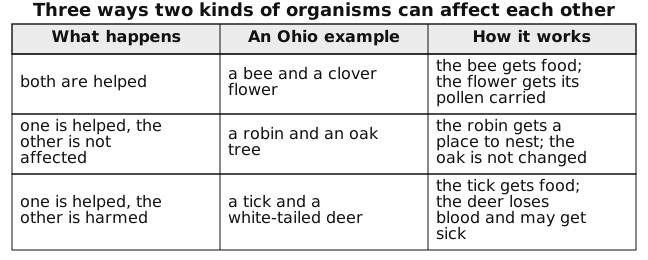
Some organisms have a close relationship with another kind of organism. The two live or feed together. A close relationship like this is called symbiosis.
There are three ways it can work out. Sometimes both organisms are helped. Sometimes one is helped and the other is not affected. Sometimes one is helped and the other is harmed.
To compare two of these relationships, ask the same question about each organism: is it helped, is it harmed, or is it not affected? The two answers together tell you which relationship you have.
New arrivals and disappearances
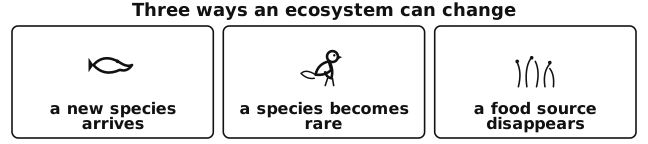
An invasive species is one that was brought to a place where it did not live before and does harm there: it competes with the organisms already there for food, eats them in large numbers, or crowds them out. Not every newcomer is invasive. The ones that do harm are.
An endangered or threatened species is one whose numbers have fallen very low. It may disappear from the ecosystem altogether.
Worked examples
Question: A new fish arrives in a lake and eats the same small insects that the native minnows eat. Predict two effects on the ecosystem.
Steps: Ask who competes. The new fish and the minnows now want the same food.
With more mouths eating them, the insect numbers are likely to fall.
With less food to go around, the minnow numbers may fall too — and then the larger fish that eat minnows have less food.
Answer: The insects would likely decrease because more animals are eating them, and the native minnows may decrease because they now have to compete for that food.
Common mistakes
A change does not stop with one organism
Removing one organism looks like it only affects whatever ate it. It rarely stops there.
That animal's numbers change, which changes what it ate and what ate it. The effect travels outward in both directions.
Check your thinking: After your first answer, ask 'and then what?' at least once more.
Ohio connection
Lake Erie and the zebra mussel
Zebra mussels are not native to Lake Erie. They arrived from elsewhere and spread widely through the lake.
They feed by filtering tiny living things out of the water — the same tiny living things that young native fish depend on. Ohio spends a great deal of effort tracking them.
Think: If zebra mussels remove much of the food that young fish rely on, predict one effect on the larger fish in the lake.
Remember
Follow it two steps
When something is removed, trace two steps. Step one: who ate it? Step two: what happens to whatever eats them? That second step is usually where the points are.
Practice tip
Remember: Trace the effect both ways.
Tip: When Ohio removes an organism from a scenario, look at what it ate AND what ate it. Full-credit answers describe both directions.
Written practice
A disease removes most of the rabbits from an Ohio meadow. Predict what happens to the grass and to the foxes, and explain why.
Sample response: The grass would likely increase, because there are far fewer rabbits eating it. The foxes would likely decrease or have to find something else to eat, because rabbits were one of their food sources. The change travels in both directions from the rabbits.
Scoring guide: 1 point: predicts the grass increases because fewer rabbits are eating it.
1 point: predicts the foxes decrease, or must find other food, because rabbits were a food source for them.
Effects in BOTH directions — what the organism ate and what ate it — is what a full-credit answer needs.
Written practice
A tick on a deer and a bee on a clover flower are both close relationships between two kinds of organisms. Explain how the two relationships are different. Tell what happens to each organism in each one.
Sample response: In the bee and clover relationship both organisms are helped. The bee gets food from the flower, and the flower gets its pollen carried to another clover plant. In the tick and deer relationship only the tick is helped. It gets food from the deer's blood, and the deer is harmed because it loses blood and can get sick. Both are close relationships, but one helps both organisms and the other helps one and harms the other.
Scoring guide: 1 point: says that in the bee and clover relationship both organisms are helped, with a reason for each.
1 point: says that in the tick and deer relationship the tick is helped and the deer is harmed.
Ohio asks students to compare symbiotic relationships, so a full answer says what happens to BOTH organisms in each one, not just which one is helped.
Section 2 · DoPractice this standard
These published practice sets are scored on the student site and cover 5.LS.1 directly.
- 01Grade 5 Science · Ecosystems and the Roles Organisms Play33 questions
- 02Grade 5 Science · Producers, Consumers and Decomposers34 questions
- 03Grade 5 Science · Food Chains and Food Webs38 questions
- 04Grade 5 Science · Ohio Science Mixed Review55 questions
- 05Grade 5 Science · OhioCore Academy Full-Length Practice Test 126 questions
- 06Grade 5 Science · OhioCore Academy Full-Length Practice Test 224 questions
- 07Ecosystems and energy: unit practice test12 questions