10.3 · Decomposers Do a Real Job
5.LS.1
Read the standard text
5.LS.1 Organisms perform a variety of roles in an ecosystem.
Section 1 · LearnLearn the idea
From Ohio 5th Grade Science Power Workbook · Chapter 10 · Lesson 10.3.
Big idea: Decomposers break down dead plants and animals, and without them an ecosystem would stop working.
Learning goals: Explain what decomposers do
Name Ohio decomposers
Predict what would happen without them
The clean-up crew that feeds the soil
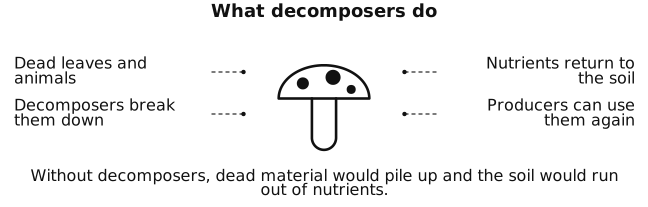
A decomposer gets its energy by breaking down dead plants and animals, and waste.
Nutrients were locked inside that dead material. Breaking it down returns them to the soil. Producers can then use them again.
Ohio decomposers
Earthworms are decomposers. So are mushrooms and other fungi, and very many living things too small to see.
They are easy to overlook, and they are doing one of the most important jobs in any ecosystem.
Worked examples
Question: A student asks what would happen to an Ohio woodland if every decomposer disappeared. Give two effects.
Steps: Ask what decomposers break down. Dead leaves, dead animals and waste.
With nothing breaking them down, that material would pile up instead of disappearing.
And the nutrients locked inside it would never return to the soil, so the producers would eventually struggle.
Answer: Dead material would pile up instead of breaking down, and nutrients would stop returning to the soil, so the producers would struggle to grow.
Common mistakes
Dead material does not just vanish
Fallen leaves disappear from a woodland floor every year, which makes it look as though rotting is something that simply happens on its own.
It does not. Living things are doing it — earthworms, fungi and enormous numbers of tiny organisms. Decomposition is a job performed by organisms.
Check your thinking: When something breaks down, ask which organisms are doing the work. There is always an answer.
Ohio connection
The floor of an Ohio woodland in November
Every autumn Ohio's woodlands drop an enormous quantity of leaves. By the following summer most of that layer has gone.
It did not evaporate. Earthworms, fungi and countless tiny organisms broke it down and returned its nutrients to the soil the trees grow in.
Think: If the leaves stopped breaking down, name one problem that would appear within a few years.
Remember
Decomposers close the loop
Producers take nutrients out of the soil. Decomposers put them back. Without that return trip, the soil would run out of nutrients.
Practice tip
Remember: Decomposers are organisms.
Tip: If a question asks what breaks down dead material, the answer names living things — earthworms, fungi, tiny organisms — never 'it just rots'.
Written practice
Explain what would happen to an ecosystem if all the decomposers disappeared. Give two effects.
Sample response: Dead plants and animals would pile up, because nothing would be breaking them down. The nutrients locked inside that dead material would never get back into the soil, so the producers would run short of what they need to grow, and eventually every consumer that depends on them would be affected too.
Scoring guide: 1 point: says dead material would build up instead of breaking down.
1 point: says nutrients would stop returning to the soil, so producers would struggle.
This targets Ohio's listed misconception that organisms play no role in decomposition.
Section 2 · DoPractice this standard
These published practice sets are scored on the student site and cover 5.LS.1 directly.
- 01Grade 5 Science · Ecosystems and the Roles Organisms Play33 questions
- 02Grade 5 Science · Producers, Consumers and Decomposers34 questions
- 03Grade 5 Science · Food Chains and Food Webs38 questions
- 04Grade 5 Science · Ohio Science Mixed Review55 questions
- 05Grade 5 Science · OhioCore Academy Full-Length Practice Test 126 questions
- 06Grade 5 Science · OhioCore Academy Full-Length Practice Test 224 questions
- 07Ecosystems and energy: unit practice test12 questions