5.3 · How Much Motion Changes
5.PS.1
Read the standard text
5.PS.1 The amount of change in movement of an object is based on the mass of the object and the amount of force exerted.
Section 1 · LearnLearn the idea
From Ohio 5th Grade Science Power Workbook · Chapter 5 · Lesson 5.3.
Big idea: How much an object's motion changes depends on the size of the force and on how much matter the object has.
Learning goals: Explain how the size of a push changes an object's motion
Explain why the same push moves a heavier object less
Describe what happens to a moving object when no force acts on it
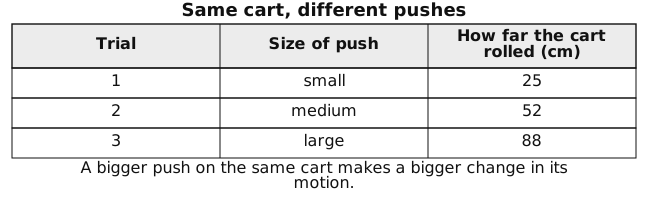
A bigger push, a bigger change
A force is a push or a pull. When a force acts on an object, the object's motion can change — it can speed up, slow down, or change direction.
Push the same cart harder and its motion changes more. That is the first half of this lesson.
More matter, less change
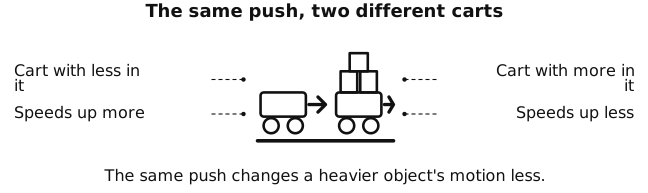
Now keep the push the same and change the cart. A cart with more matter in it changes its motion less than a cart with less in it.
Scientists call the amount of matter in an object its mass. More mass means more matter.
So two things decide how much the motion changes: how big the force is, and how much matter the object has.
No force, no change
Here is the part that surprises people. An object already moving at a steady speed does not need a force to keep going.
If no force acts on it, or if the forces on it are balanced, it keeps moving at the same speed in the same direction. A force is needed to change motion, not to continue it.
Worked examples
Question: Two identical carts are pushed with the same force. One is empty and one is loaded with books. Which one speeds up more, and why?
Steps: Check what is the same. The force is the same for both.
Check what is different. One cart has much more matter in it.
The same force makes a smaller change in the motion of the cart with more matter.
Answer: The empty cart speeds up more, because the same push makes a bigger change in the motion of an object with less matter in it.
Common mistakes
A moving object does not need a push to keep moving
Everything we push on Earth slows down and stops, so it feels obvious that motion needs constant pushing.
What actually stops those objects is another force — rubbing against the ground or the air. With no force at all, a moving object would just keep going at the same speed.
Check your thinking: Ask what is changing. A force is needed to change motion, not to keep it going.
A force does not always change motion
You can push a wall with all your strength and nothing moves at all.
That is because the forces on the wall are balanced: the ground and the rest of the building hold it in place against your push. Motion changes only when the forces acting on an object are unbalanced.
Check your thinking: Before deciding the motion changed, ask whether other forces on the object balance the push.
Ohio connection
Loading a truck on an Ohio highway
A truck leaving a loading dock full of freight takes far longer to get up to highway speed than the same truck running empty.
Nothing about the engine changed. There is simply more matter to get moving, so the same force makes a smaller change in the motion.
Think: A loaded truck also takes longer to stop. Explain why, using what you know about force and matter.
Remember
Bigger push, bigger change. More stuff, less change.
Two sentences cover this whole lesson. Bigger push, bigger change. More matter, less change. Almost every question here is one of those two.
Practice tip
Remember: Ohio asks about CHANGE in motion.
Tip: Read the question for the word change. A force does not make something move forever — it changes how something is moving. That wording is the whole content statement.
Written practice
A shopping cart is easy to start moving when it is empty and hard when it is full. Explain why, using the words force and matter.
Sample response: The full cart has much more matter in it than the empty one. The same force makes a smaller change in the motion of an object with more matter, so you have to push harder to get the full cart moving the same amount.
Scoring guide: 1 point: says the full cart has more matter in it.
1 point: explains that the same force makes a smaller change in the motion of an object with more matter, so a bigger force is needed.
This is the relative-matter-and-force relationship Ohio assesses for 5.PS.1.
Section 2 · DoPractice this standard
These published practice sets are scored on the student site and cover 5.PS.1 directly.
- 01Grade 5 Science · Motion, Distance, Time and Speed22 questions
- 02Grade 5 Science · Balanced and Unbalanced Forces27 questions
- 03Grade 5 Science · Ohio Science Mixed Review55 questions
- 04Grade 5 Science · OhioCore Academy Full-Length Practice Test 126 questions
- 05Grade 5 Science · OhioCore Academy Full-Length Practice Test 224 questions