4.3 · Shadows Through the Day
5.ESS.3
Read the standard text
5.ESS.3 Most of the cycles and patterns of motion between the Earth and sun are predictable.
Section 1 · LearnLearn the idea
From Ohio 5th Grade Science Power Workbook · Chapter 4 · Lesson 4.3.
Big idea: As the sun's apparent position changes through the day, every shadow changes length and direction in a predictable way.
Learning goals: Describe how a shadow changes during a day
Use shadow data to work out the time of day
Explain what causes a shadow to change
Low sun, long shadow
A shadow forms where an object blocks the sunlight. Its length depends on how high the sun appears in the sky.
Early and late in the day the sun appears low, and shadows are long. Around the middle of the day the sun appears highest, and shadows are short.
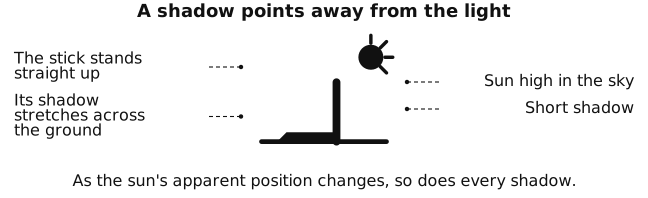
The shadow swings around too
A shadow always points away from the light. As the sun appears to move across the sky, the shadow swings around to the opposite side.
That is why a shadow's direction tells you roughly what time it is — and why a sundial works.
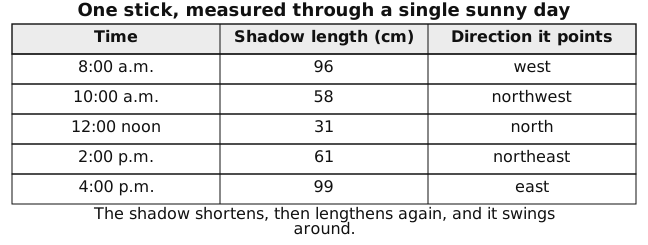
Worked examples
Question: Use the shadow table. A student measures a 30 cm shadow from the same stick. About what time of day is it, and how do you know?
Steps: Find where 30 cm sits in the data. The shortest measurement in the table is 31 cm, at noon.
A 30 cm shadow is about that short, so the sun must be near its highest apparent point.
That happens around the middle of the day.
Answer: About midday. The shadow is at its shortest, which happens when the sun appears highest in the sky.
Common mistakes
Shadows do not stay the same
You usually glance at your shadow for a second and move on, so it is easy to assume it always looks like that.
Measure it twice in one day and the difference is obvious. A shadow that was longer than you in the morning can be shorter than you by midday.
Check your thinking: Never answer a shadow question from memory. Ask where the sun appears to be at the time the question gives you.
Remember
Sun high, shadow shy
Two words to keep them straight. Sun high, shadow shy — short. Sun low, shadow grow — long.
Investigation
Track a shadow through one day
Question: How does a shadow change during a single day?
Safety: Never look directly at the sun, even for a moment. Watch the shadow on the ground, not the sky.
Materials: a stick or ruler that can stand upright
modeling clay or a cup of sand to hold it up
a large sheet of paper or chalk on a sidewalk
a ruler or tape measure
a clock
Steps: Stand the stick upright on the paper in a sunny spot. Mark exactly where the paper and the stick sit so nothing moves.
In the morning, mark the tip of the shadow and write the exact time from the clock beside it.
Measure the shadow from the base of the stick to your mark and record it. Also record which way the shadow points: toward which wall, tree or side of the paper.
Do the same again around midday, without moving anything.
Do it a third time in the afternoon.
On the next sunny day, repeat all three at about the same times, with the stick in the same spot, to check your results.
Look at your marks together and describe the pattern.
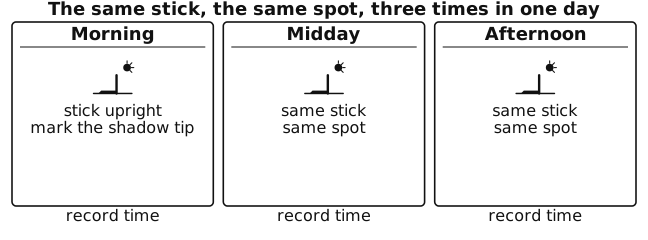
Fair: The stick and the paper must not move at all between measurements, and each measurement is taken the same way from the base of the stick. The only thing changing is the time of day.
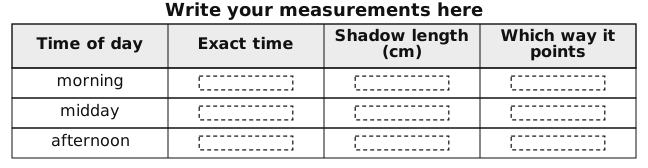
Cer: Prompt: How did the shadow change during the day, and what caused it?
Claim hint: Describe the pattern you found in one sentence.
Ev hint: Give your measurements from both trials, with their times and units, and say whether Trial 2 matched Trial 1.
Re hint: Explain what is happening with Earth and the sun that makes the shadow change that way.
Practice tip
Remember: Shadow questions are really sun-position questions.
Tip: Every time Ohio asks about a shadow, work out where the sun appears to be at that time first. The shadow follows from it: high sun, short shadow, pointing away.
Written practice
Explain why a shadow changes length during the day. Use the words sun and Earth in your answer.
Sample response: A shadow is short when the sun appears high in the sky and long when the sun appears low. The sun's apparent position changes through the day because Earth is rotating, so the shadow keeps changing too.
Scoring guide: 1 point: links shadow length to how high the sun appears in the sky.
1 point: explains that the sun's apparent position changes because Earth is rotating.
Full credit needs both the pattern (high sun, short shadow) and its cause (Earth's rotation moves the sun's apparent position).
Section 2 · DoPractice this standard
These published practice sets are scored on the student site and cover 5.ESS.3 directly.