4.1 · Day and Night
5.ESS.3
Read the standard text
5.ESS.3 Most of the cycles and patterns of motion between the Earth and sun are predictable.
Section 1 · LearnLearn the idea
From Ohio 5th Grade Science Power Workbook · Chapter 4 · Lesson 4.1.
Big idea: Earth turns once in about 24 hours. The half facing the sun has day; the half facing away has night.
Learning goals: Explain what causes day and night
State about how long one rotation takes
Explain why it is not day everywhere at once
Earth turns
Earth spins like a top. One full turn is called a rotation, and it takes about 24 hours.
The sun shines on only half of Earth at a time. Wherever you are, you have day while your half faces the sun, and night while it faces away.
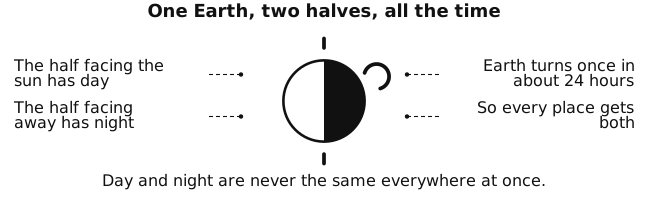
Somewhere it is always night
Because only half of Earth is lit at once, day and night happen in different places at the same moment.
While it is the middle of the afternoon in Ohio, there are places where people are asleep in the dark.
Worked examples
Question: It is 3 p.m. in Ohio and bright daylight. A student says it must therefore be daytime everywhere on Earth. Explain why that is wrong.
Steps: Ask how much of Earth the sun can light at once. Only half of it.
So while Ohio's half faces the sun, the other half faces away.
That means places on the far side are in night at the very same moment.
Answer: The sun lights only half of Earth at a time, so while Ohio has afternoon, places on the other half are in night.
Common mistakes
It is not day everywhere at the same time
When it is light outside your window it is easy to picture the whole planet in daylight.
Only half of Earth can face the sun at once. The other half is in night at that exact moment.
Check your thinking: Picture a ball with a flashlight on one side. Half lit, half dark, always.
Ohio connection
Sunrise in Ohio is not sunrise everywhere
When the sun comes up over Lake Erie, people far to the west are still in darkness, and people far to the east have had daylight for hours.
That is why clocks are set differently in different parts of the world. The turning of Earth reaches places at different times.
Think: If Earth stopped turning, what would happen to day and night in Ohio?
Remember
Half lit, half dark, always turning
Three facts hold this whole lesson. Half of Earth is lit. The other half is dark. Earth keeps turning, so every place takes its turn in both.
Practice tip
Remember: Rotation and revolution are easy to swap.
Tip: Rotation is Earth turning on itself, about 24 hours, and it makes day and night. Revolution is Earth going around the sun, about 365 days, and it makes a year.
Written practice
Use a model to explain what causes day and night. Describe what you would use for Earth and for the sun, and what you would do.
Sample response: I would use a flashlight for the sun and a ball for Earth, with a sticker on the ball for Ohio. With the flashlight shining on one side, I would slowly turn the ball. The sticker moves into the light, which is day, then around into the dark, which is night.
Scoring guide: 1 point: describes a model with a light source for the sun and a turning ball for Earth.
1 point: explains that turning the ball carries a marked spot from the lit side to the dark side, which is day becoming night.
Ohio lists creating a model to demonstrate that rotation produces night and day in a 24-hour period as a response attribute.
Section 2 · DoPractice this standard
These published practice sets are scored on the student site and cover 5.ESS.3 directly.