3.1 · The Sun Is a Star
5.ESS.2
Read the standard text
5.ESS.2 The sun is one of many stars that exist in the universe.
Section 1 · LearnLearn the idea
From Ohio 5th Grade Science Power Workbook · Chapter 3 · Lesson 3.1.
Big idea: The sun is a star. It is the closest one to Earth, and the only one in our solar system.
Learning goals: Explain that the sun is a star
Describe the sun in general terms
Compare the size of the sun with Earth
The same kind of object
The sun and the points of light you see at night are the same kind of object. The sun is a star.
It is a huge ball of hot gas. There is no solid ground anywhere on it, so there is nowhere a spacecraft could land.
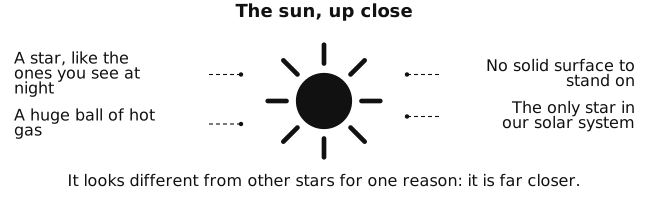
Much larger than Earth
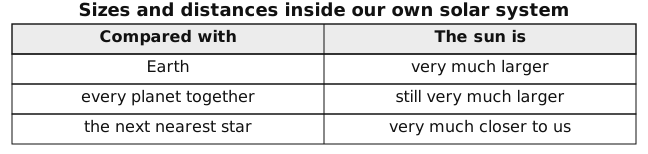
The sun is very much larger than Earth. If the sun were the size of a beach ball, Earth would be smaller than a pea.
It is also the only star in our solar system. Every planet here orbits this one star.
Worked examples
Question: A student says the sun cannot be a star because stars only come out at night. What is wrong with that reasoning?
Steps: Ask what actually changes between day and night. The stars do not go anywhere; they are there all the time.
Ask why we cannot see them in daytime. The sun is so close and so bright that its light fills our sky.
So the sun being visible in the day is a sign of how near it is, not a sign that it is a different kind of object.
Answer: Stars are there all day. The sun is simply so close and bright that we cannot see the others while it is up. The sun is a star.
Common mistakes
The sun really is a star
The sun looks nothing like the tiny sparks in a night sky, so it is easy to put it in a different group.
It belongs in the same group. The only reason it looks so different is that every other star is enormously farther away.
Check your thinking: Ask what would happen if you moved the sun very far away. It would look like a tiny point too.
There is nowhere to land on the sun
Pictures of the sun show a clear round edge, which makes it look like a solid ball.
The sun is gas the whole way. The edge you see is where the glowing gas becomes thin enough to see through, not a surface.
Check your thinking: A round outline is not the same as solid ground. Ask what it is made of, not what shape it looks.
Ohio connection
Why Ohio's summer sky looks different from its winter sky
Stand in a dark Ohio field in January and again in July and you will see different star patterns overhead.
Nothing moved the stars. Earth traveled to the other side of its orbit, so at night we face out toward a different part of space.
Think: The sun is in our sky during the day. Why does that stop us seeing other stars at the same time?
Remember
Same family, different seat
The sun and the night stars are the same family of object. The sun just has the closest seat, by an enormous margin.
Practice tip
Remember: Ohio asks about the sun in general terms.
Tip: You will not be asked the sun's age, its temperature or exactly what it is made of. You will be asked whether it is a star, roughly how big it is compared with Earth, and why it looks so different from other stars.
Written practice
A classmate says, “The sun is not a star, because stars are tiny and the sun is huge.” Explain what is wrong with this reasoning.
Sample response: The sun is a star. The other stars look tiny because they are enormously farther away from us than the sun is. If the sun were that far away, it would look like a tiny point too.
Scoring guide: 1 point: states that the sun IS a star.
1 point: explains that other stars only look tiny because they are very much farther away.
Distance, not real size, is what makes other stars look small. This is the core idea of 5.ESS.2.
Section 2 · DoPractice this standard
These published practice sets are scored on the student site and cover 5.ESS.2 directly.