2.5 · Tools That Study the Solar System
5.ESS.1
Read the standard text
5.ESS.1 The solar system includes the sun and all celestial bodies that orbit the sun. Each planet in the solar system has unique characteristics.
Section 1 · LearnLearn the idea
From Ohio 5th Grade Science Power Workbook · Chapter 2 · Lesson 2.5.
Big idea: Different tools answer different questions, and each part of a space probe has a job.
Learning goals: Choose the right tool to study part of the solar system
Explain what the parts of a probe do
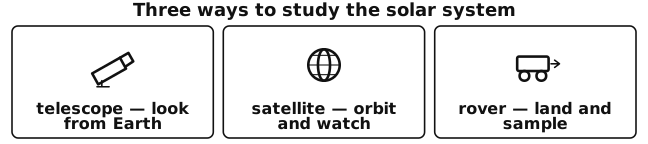
Look, orbit, or land
A telescope on Earth collects light from far away. It is good for studying many objects, but it cannot get close.
A satellite orbits an object and watches it for a long time from nearby.
A rover or lander touches down on a surface and can test the material directly. That only works where there is a solid surface.
Each part has one job
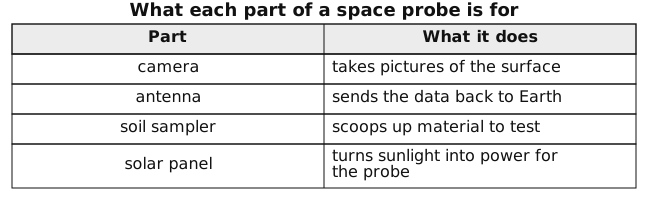
A probe is built from parts that each do something. A camera takes pictures. An antenna sends the data home. A soil sampler scoops up material to test. A solar panel turns sunlight into power.
If a question asks which part you need, decide what job has to be done first.
Worked examples
Question: Scientists want to scoop up some soil from a rocky planet and test it on the spot. Which tool should they send, and which part matters most?
Steps: Decide what job has to be done. To pick up soil and test it, the tool has to be on the ground. Other instruments can learn a lot about a surface from far away, but they cannot collect anything.
Pick the tool that can reach it. A lander or rover can touch the surface.
Pick the part that does the job: a soil sampler collects the material, and an antenna then sends the results back.
Answer: Send a lander or rover, and the soil sampler is the part that matters most, with an antenna to send the results back.
Common mistakes
A bigger tool is not always the right tool
A huge telescope is amazing, but it cannot tell you what soil feels like. A rover is amazing too, and it can only visit one place.
The question to ask is not which tool is most powerful. It is which tool can do the job the question describes.
Check your thinking: Name the job first — look, watch closely, or touch — then pick the tool that does that job.
Ohio connection
Space research just outside Cleveland
NASA's Glenn Research Center sits near Cleveland, named after the Ohio astronaut John Glenn. Engineers there work on power systems and propulsion for spacecraft.
So some of the parts that let a probe reach another planet and send its data home are worked on in Ohio.
Think: A probe needs power the whole time it is working. Why would a solar panel be a good choice close to the sun and a poor one far out?
Remember
Look, watch, touch
Three jobs, three tools. Look from far away — telescope. Watch closely for a long time — satellite in orbit. Touch and test — lander or rover.
Practice tip
Remember: Match the tool to the job.
Tip: Ohio's tool questions describe a job — look, watch for a long time, or touch and test — then ask which tool or which part fits. Decide the job first.
Written practice
A team wants to find out whether a dwarf planet has ice on its surface. Describe one tool they could use and explain why it fits the job.
Sample response: They could send a probe to orbit the dwarf planet and take pictures and measurements of the surface. An orbiter can get close enough to see detail a telescope on Earth cannot, and it can keep watching instead of taking one picture.
Scoring guide: 1 point: names a workable tool — a telescope, an orbiting satellite, or a lander with a sampler.
1 point: explains why that tool suits the job, matching what the tool can actually do to what has to be found out.
Ohio lists planning an investigation with the appropriate tools as a response attribute for this statement.
Section 2 · DoPractice this standard
These published practice sets are scored on the student site and cover 5.ESS.1 directly.